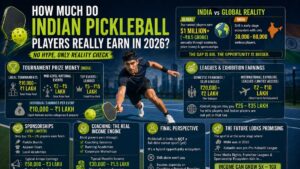
Who Is Responsible for the Lack of Media Coverage of Pickleball in India? Let’s Face the Hard Realities:
Pickleball in India is growing—quietly but consistently. Courts are being built, communities are forming, and participation numbers are rising across metro and Tier-2 cities. Yet, when you switch on sports news or scroll through mainstream sports platforms, the sport is almost invisible.
The obvious question everyone asks is: Why isn’t the media covering Pickleball?
But the real answer is far more layered—and slightly uncomfortable.
Because the truth is: it’s not just the media’s fault.
The TRP Reality: Media Follows Demand, Not Potential
Media houses operate on a simple principle—audience attention drives revenue. Whether it’s television ratings (TRPs), digital clicks, or social media engagement, coverage is dictated by measurable demand.
At present, Pickleball in India lacks consistent, large-scale viewership data. Unlike cricket, kabaddi, or even emerging leagues in football, there is no strong evidence yet that Pickleball content can deliver sustained eyeballs.

This doesn’t mean the sport lacks potential—it simply means it hasn’t yet proven its ability to command mass attention. And in a competitive media environment, potential alone isn’t enough.
Fragmented Federations: No Unified Voice
One of the biggest structural challenges is the lack of a unified governing narrative.
Multiple federations, associations, and independent organizers are working to grow the sport—but often in silos. This fragmentation leads to:
Confused messaging
Inconsistent branding
Lack of centralized PR efforts
Without a single, strong voice driving the sport’s story, media houses struggle to find a clear entry point. Compare this with established sports where governing bodies actively manage storytelling, media relations, and narrative building.
In Pickleball’s case, the story exists—but it’s scattered.
Events Without Amplification
Leagues and tournament organizers have done commendable work in bringing Pickleball to the ground level. Events are happening, participation is increasing, and infrastructure is slowly improving.
However, there is a critical gap: content distribution.
Most organizers focus heavily on execution—venues, logistics, player management—but underinvest in:
Live streaming quality
Post-event content
Highlight packages
Media partnerships
In today’s attention economy, an event that isn’t amplified digitally is almost invisible. It’s not enough to host a great tournament—it needs to be seen, shared, and talked about.
Brands and the ROI Dilemma
Brands play a crucial role in scaling any sport. But brands are cautious—and for good reason.
From a marketing perspective, investment decisions are driven by clear return on investment (ROI). Currently, Pickleball struggles to offer:
Strong audience metrics
Defined target demographics at scale
Proven engagement benchmarks
Without these, brands hesitate to commit significant budgets. And without brand investment, large-scale storytelling becomes even more difficult.
It’s a cycle—and right now, Pickleball is still trying to break into it.
Creators and Journalists: The Missing Push
This is where the conversation becomes self-reflective.
Creators, journalists, and content producers—including those within emerging sports ecosystems—haven’t yet scaled Pickleball storytelling to its full potential.
Cricket didn’t become dominant purely because of institutional support. It became dominant because:
Stories were told consistently
Players became personalities
Rivalries were amplified
Moments were made viral
Pickleball has stories—but they are not being packaged or distributed at scale.
There is a lack of:
Deep-dive player profiles
Narrative-driven documentaries
Viral short-form content
Regional storytelling that connects emotionally
In short, the storytelling engine is still underdeveloped.
The Real Problem: A Storytelling Ecosystem Gap
So, does Pickleball have a media coverage problem?
Not exactly.
It has a storytelling ecosystem problem.
Media is not the starting point—it’s the amplifier. For media to engage, there needs to be a steady pipeline of compelling narratives that demand attention.
Right now, that pipeline is inconsistent.
What Needs to Change?
For Pickleball to break into mainstream media consciousness, it needs to build:
1. Consistent Narratives
Regular, structured storytelling around tournaments, players, and growth trends.
2. Player Rivalries
Sport thrives on competition. Fans connect with stories of conflict, dominance, and redemption.
3. Regional Heroes
India’s diversity is its strength. Identifying and promoting local champions can unlock new audiences.
4. Viral Content Pipelines
Short-form, high-engagement content tailored for platforms like Instagram, YouTube Shorts, and X (Twitter).
5. Integrated Media Strategy
A coordinated effort between federations, leagues, creators, and brands to push unified messaging.
The Opportunity: A First-Mover Advantage
Despite the challenges, the opportunity is enormous.
Pickleball is still in its early growth phase in India. This means:
Narratives are yet to be defined
Heroes are yet to be fully established
Content formats are still evolving
For creators, leagues, and brands, this is the perfect moment to step in—not as followers, but as first movers.
Those who invest in storytelling today will shape how the sport is perceived tomorrow.
Final Thought
Cricket didn’t grow because media supported it.
Media supported cricket because its stories were impossible to ignore.
Pickleball in India is on the verge of something similar—but only if the ecosystem steps up collectively.
Because in today’s world, the sport that wins attention… wins everything.
So the real question is:
What do you think is the biggest gap—media, federations, or creators?
The conversation is just getting started.
Pickleball Media Coverage in India — Reality Breakdown:
| Section | Key Issue | What’s Happening | Impact on Media Coverage | What Needs to Change |
|---|---|---|---|---|
| Overall Context | Low visibility despite growth | Courts, communities, and participation increasing steadily | Sport remains largely invisible in mainstream media | Build visibility through structured storytelling |
| TRP Reality | Media follows demand, not potential | Lack of consistent, large-scale viewership data | Media hesitant to allocate coverage without proven audience | Generate measurable engagement (views, clicks, TRPs) |
| Federation Structure | Fragmentation | Multiple bodies working independently | Confused messaging, weak PR, no single narrative | Create unified governing voice and central PR strategy |
| Event Ecosystem | Poor amplification | Good on-ground events but limited digital push | Events fail to reach wider audience | Invest in streaming, highlights, and media partnerships |
| Brand Investment | ROI uncertainty | No strong audience metrics or engagement benchmarks | Brands hesitant to invest heavily | Define audience segments and prove ROI through data |
| Content & Creators | Weak storytelling engine | Limited player stories, rivalries, or viral content | Low emotional connection with audience | Scale storytelling: documentaries, reels, player profiles |
| Media Role | Not the root problem | Media acts as amplifier, not originator | Lack of consistent content pipeline reduces coverage | Build continuous narrative flow before media push |
| Core Problem | Storytelling ecosystem gap | Stories exist but are scattered and inconsistent | No sustained attention or momentum | Develop structured storytelling ecosystem |
| Narrative Building | Inconsistent storytelling | No regular flow of engaging content | Audience fails to stay connected | Create consistent narratives across platforms |
| Rivalries & Personalities | Missing competitive narratives | No defined rivalries or star players | Reduced fan engagement | Build player rivalries and personalities |
| Regional Growth | Untapped local stories | Lack of focus on regional heroes | Missed opportunity in Tier-2/3 markets | Promote regional champions and local stories |
| Digital Strategy | Weak short-form presence | Limited viral or shareable content | Low discoverability on social platforms | Build strong short-form content pipeline |
| Media Strategy | Lack of coordination | Disconnected efforts across stakeholders | Inefficient reach and messaging | Align federations, brands, creators, and leagues |
| Opportunity | Early-stage advantage | Sport still evolving in India | Space open for first movers | Invest now to shape narratives and perception |
| Final Insight | Attention economy rules | Media follows compelling stories | Pickleball lacks “must-cover” narratives | Build stories that demand attention |
Closing Insight (for presentation use)
| Key Takeaway | Explanation |
|---|---|
| It’s not a media problem | Media amplifies what already has momentum |
| It’s a storytelling problem | Lack of consistent, engaging narratives |
| Biggest Opportunity | First movers can define the sport’s future in India |
| Question | Answer |
|---|---|
| Q1: Why is the Indian media ecosystem hardly covering Pickleball in 2026? | The Indian media ecosystem is not solely at fault. One major reason is that Pickleball still lacks deeply compelling, mass-scale stories and achievement narratives like those seen in cricket. Media houses in India primarily focus on TRPs, audience numbers, and revenue generation, which is natural for any business. They tend to prioritize stories that attract large audiences. Instead of blaming the media, stakeholders in the Pickleball ecosystem need to create stronger storytelling, structured promotion strategies, and engaging narratives to make the sport more appealing to a wider audience. |
| Q2: How many media platforms are covering the Pickleball ecosystem in India? | Currently, only a handful of media platforms are actively covering Pickleball in India. These include Pickleball Now, Pickleball Official, Global Sports, and PicklersTalks. However, the ecosystem still lacks widespread media participation. If internal issues like federation disputes are resolved and the ecosystem becomes more structured, media coverage is expected to grow significantly. |
Related posts: