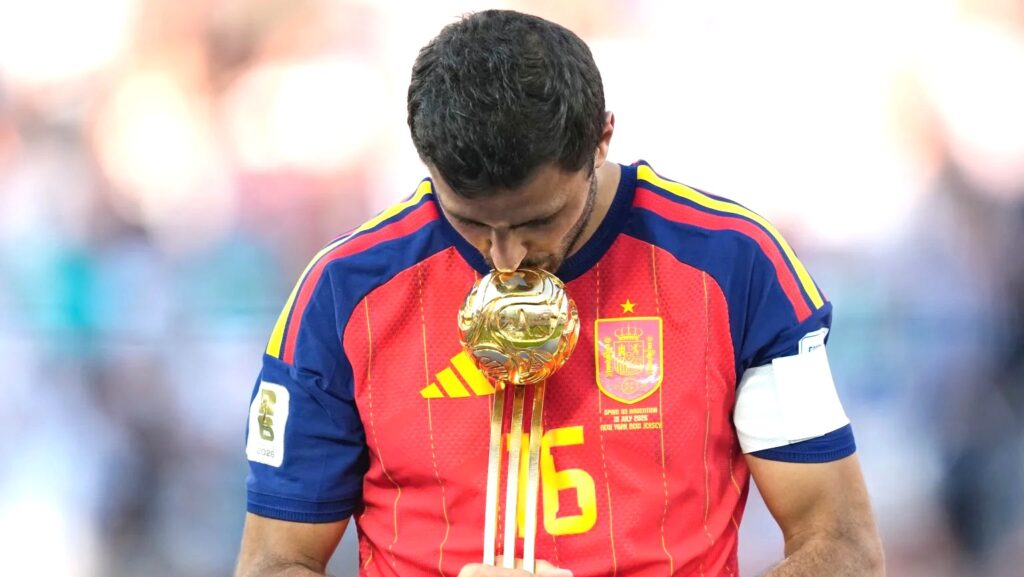
Sixteen years before Rodri lifted the World Cup trophy in East Rutherford, he was living a very different life just 100 miles away, in the forests of Connecticut. He was a teenager then, sent by his father on a student exchange program. His father hoped that life in America would change his son’s mind about football and push him toward studies instead.
But Rodri had other plans. Football was already in his heart, and nothing could shake it loose.
For a boy from a quiet Madrid suburb called Villanueva de la Cañada, Connecticut felt like a different planet. He later wrote in the Player’s Tribune that it felt like stepping into a Hollywood movie. There were wooden canoes, tall trees to climb, and tents to sleep in. Everything about this new world was strange and new for him.
When Soccer Became a Joke
One day, Rodri asked his new friends to play football with him. They misunderstood and thought he meant American football. He had to explain that he meant soccer, not the sport with helmets and pads. His friends were surprised that anyone would want to play “soccer” for fun.
Since nobody wanted to join him, Rodri played alone. He kicked the ball around in the summer heat and in the freezing winter. He didn’t complain. In fact, he grew to enjoy the different version of the sport he found there, even while staying loyal to football in his heart.
Slowly, Rodri picked up English, and he did it fast. He even picked up a Connecticut accent that made his friends like him even more. This quick learning skill would show up again later in his life, when he needed to adapt to two very different football coaches.
Missing Home During the World Cup
Things changed when the World Cup started. Rodri had no internet access at his camp, and this made him restless. He said it was painful not knowing what was happening with his team back home.
There was one old computer in the main office, and every day Rodri would ask the camp counselors for score updates. When Spain lost their first match to Switzerland, Rodri could not believe it. He thought the counselors were joking with him.
As the tournament moved into the knockout rounds, the counselors began telling him the results without him even asking. He was out canoeing on a lake when Spain beat Germany in the semifinal. He said he had never felt so far from home, yet somehow so close to it at the same time.
For the final, Rodri begged the counselors to let him use the computer. They agreed, but the internet was weak, so he had to find an illegal stream to watch the match. When Iniesta scored the winning goal, Rodri screamed and ran outside. He sprinted around the entire lake in excitement. His friends thought he had gone crazy.
Sixteen years later, those same friends would finally understand why he screamed that day. The boy who once ran wild around a lake in Connecticut was now holding the World Cup trophy above his head.
The Long Road Back Home
The journey from that Connecticut lake to the streets of East Rutherford took many years to complete. When Rodri returned home after his exchange program, his father was disappointed to see that his son still loved football just as much as before. Eventually, his father let him follow his dream.
Rodri once compared football to a drug, something he simply could not stay away from. He moved through the academies of Atletico Madrid and Villarreal before returning to Atletico as a full grown player. It was there that he met the manager who would shape a big part of his game: Diego Simeone.
Learning to Be Tough
Simeone quickly noticed that Rodri had wonderful skills with the ball but lacked a certain toughness on the field. Rodri later explained that under Simeone, he learned how to be the bad guy on the pitch when needed. He learned how to make life difficult for the opposing team for the full 90 minutes.
What makes Rodri special is that he never needs to commit rough fouls to be tough. His sense of position on the field is so sharp that he rarely finds himself out of place. Many people think defensive midfielders are always the tackling, rough type of players. But the truly great ones are not like that at all.
Players like Claude Makelele, Sergio Busquets, N’Golo Kante, and now Rodri share this same quality. They always seem to have more time and space than everyone else on the field. They understand the game so well that they know exactly where the ball is going before it even gets there.
During the World Cup, Rodri was ranked 97th on the list of players who commit fouls. This makes his award even more surprising. He won the Golden Ball as the tournament’s best player without scoring a single goal or setting up an assist. He didn’t top any attacking or defensive charts either. Even his passing accuracy placed him only 44th among all players.
The Guardiola Influence
So what actually made Rodri the most valuable player of the tournament? The answer lies with his second major coach, Pep Guardiola. Guardiola once said that the way Rodri sees the game is different from everyone else. His understanding of football’s finest details is described as almost like watching from above, seeing the whole picture at once.
When Rodri first joined Manchester City, he was nowhere close to being the key player he is today. Guardiola gave him simple advice: don’t run around too much, and only move when it’s truly needed. Guardiola himself was amazed at how quickly Rodri learned and changed his game based on this advice.
Within a year, Rodri became a player City simply could not do without. The team’s success began to depend heavily on whether he was fit and available to play. Guardiola explained that people usually focus only on goal scorers, but football is about so much more than that. According to him, Rodri controlled every single match he played. He set the pace of the game, protected the defense, won back the ball, and started attacks. Most importantly, he gave every teammate around him the confidence to play their own natural game.
Taming Messi in the Final
In the World Cup final, Rodri managed to tie up Lionel Messi so completely that Messi started avoiding him. Rodri forced Messi to use his right foot more often, which is dangerous but nowhere near as deadly as his natural left foot.
Watching Rodri play might have reminded Messi of his old teammate Sergio Busquets from his Barcelona days. Just like Busquets, Rodri cannot be judged by simple stats. Calling him a defensive midfielder ignores everything he adds to the attack. Calling him just a tempo-setter also misses the full picture of what he does on the field.
Spain’s head coach Luis de la Fuente has a perfect name for Rodri’s role: the traffic controller. His job isn’t as flashy as a secret agent, but he controls everything happening around him on the field. He is like the center point of a compass that allows Spain to move in perfect circles around him. His mere presence on the field takes away half the confidence of the opposing team. Argentina, having faced him in the final, would understand this feeling better than anyone.
A Player Who Cannot Be Defined
Rodri exists in his own unique space in football. He sets the tempo of games while also being a holding midfielder. He learned from both Simeone and Guardiola, two coaches with completely different footballing philosophies. He conducts the game like an orchestra leader while also being the star performer himself.
At heart, he remains the true Madrid boy who once spoke English with a strong Connecticut accent, picked up during that unusual summer camp so many years ago. Today, he stands as the best midfielder in the world, a player whose true value can never be captured by numbers alone, and whose role on the field refuses to fit into any single box.
Related posts: