We’re in 2026… but the story hasn’t changed at all in India.
India still celebrates sports through a cricket-first lens.
And in that noise, we continue to overlook the people doing the real groundwork —
The journalists, storytellers, and stakeholders who are consistently covering non-cricket sports.
These are the people:
Travelling without big budgets
Covering events without prime-time slots
Telling stories that rarely go viral
Yet showing up every single day
And still…
They don’t get the credit they deserve.
This isn’t just about journalism.
This is about mindset.
A country that calls itself a sporting nation cannot afford to be obsessed with just one sport.
Because real sporting culture isn’t built on:
TRPs
Sponsorship bias
Or algorithm-driven visibility
It is built on stories from the ground up.
🏑 A hockey player’s struggle
🤼 A wrestler’s journey
🏸 A badminton player’s rise
🏓 A table tennis athlete’s grind
** Pickleball ecosystem in India
If these stories don’t reach people,
we are not growing sports — we are limiting it.
The real question is:
Do we want to remain a cricket-obsessed nation?
Or become a true sports-loving nation?
Because the difference is simple:
👉 A cricket nation celebrates moments
👉 A sports nation builds ecosystems
But here’s the deeper reality we often ignore —
Ecosystems are not built overnight.
They are built through years of consistent storytelling, visibility, and belief.
And storytelling is where everything begins.
Before an athlete becomes a champion,
before brands start investing,
before federations receive attention —
There is always a story.
A story of struggle.
A story of sacrifice.
A story of resilience that deserves to be seen and heard.
In countries where sports culture thrives,
media doesn’t wait for medals to tell stories.
They tell stories before the podium.
They follow journeys, not just results.
But in India, the narrative often works in reverse.
We celebrate athletes after they win.
We notice sports after they trend.
And by then, we’ve already missed years of untold effort.
This gap is exactly where non-cricket journalists step in.
They are not just covering sports —
they are preserving the foundation of India’s sporting future.
They are the ones sitting in empty stands,
streaming matches with minimal resources,
writing stories that may not get clicks today,
but will define history tomorrow.
And yet, their work often goes unnoticed.
Why?
Because visibility today is dictated by algorithms,
and algorithms favor what is already popular.
It’s a cycle:
Popular sports get more coverage →
More coverage brings more audience →
More audience attracts more sponsors →
And the cycle continues.
Meanwhile, emerging sports are left fighting for scraps of attention.
This is where mindset becomes everything.
If audiences consciously choose to explore beyond cricket,
if brands consciously invest beyond cricket,
if platforms consciously amplify beyond cricket —
The ecosystem starts shifting.
And this shift is already waiting to happen.
Look at the rise of sports like badminton and wrestling over the last decade.
Look at how leagues have slowly started building interest in kabaddi.
Look at how pickleball is quietly entering urban conversations in India.
These are not accidents.
These are early signs of change.
But the pace is still slow.
And the biggest reason is — attention is still concentrated, not distributed.
Imagine a scenario where:
A district-level table tennis tournament gets the same storytelling effort as a league match.
A young hockey player’s journey is documented like a cricket prodigy’s rise.
A grassroots pickleball coach is highlighted as much as a celebrity athlete.
That’s when ecosystems truly begin to grow.
Because ecosystems are not built by stars alone.
They are built by:
Coaches
Grassroots organizers
Local academies
Independent media
And most importantly — consistent storytelling
If we fail to acknowledge these layers,
we are not just ignoring stories —
we are weakening the entire sports structure.
And this has long-term consequences.
Because when young athletes don’t see visibility in their sport,
they don’t see a future in it.
When parents don’t see recognition,
they hesitate to support it.
When brands don’t see attention,
they don’t invest in it.
And when media doesn’t cover it,
the cycle of invisibility continues.
This is why your voice — as a storyteller, creator, or even a fan — matters more than ever in 2026.
Today, we are no longer dependent only on traditional media.
We have platforms.
We have tools.
We have the ability to amplify stories ourselves.
A single post,
a single video,
a single thread —
Can bring attention to a sport that was previously ignored.
That’s the power shift of this decade.
But the question is — are we using it responsibly?
Are we using it only to consume viral cricket clips?
Or are we using it to discover and amplify untold stories?
Because the future of Indian sports will not be decided only in stadiums.
It will be decided on:
Social feeds
Content platforms
And storytelling ecosystems
If we continue to scroll past non-cricket stories,
we are silently choosing to limit India’s sporting growth.
But if we start engaging, sharing, and supporting —
we become part of the solution.
Not from federations.
Not from billion-dollar deals.
But from a shift in collective mindset.
So the next time you see:
A wrestling story with low views
A badminton interview with limited reach
A pickleball event with minimal buzz
Pause.
Engage with it.
Share it.
Support it.
Because growth doesn’t come from what’s already big.
Growth comes from what we choose to lift.
India has the talent.
India has the passion.
India has the potential to be a global sporting powerhouse.
But to truly become one,
we need to move beyond a single-sport identity.
We need to build a culture where every sport matters,
every story counts,
and every voice is heard.
Only then will India not just produce champions…
But respect every journey that creates one.
| Section | Key Idea / Message | Details / Explanation |
|---|---|---|
| Context | India in 2026 | Despite growth, India still views sports largely through a cricket-first lens |
| Core Problem | Cricket Dominance | Overshadows other sports, limiting exposure and growth |
| Ignored Contributors | Non-Cricket Journalists | Travel without budgets, cover events without prime-time, tell stories that rarely go viral |
| Ground Reality | Lack of Recognition | These contributors consistently show up but don’t get due credit |
| Bigger Issue | Mindset Problem | Not just a media issue, but a national mindset challenge |
| Sporting Identity | True vs Limited | A true sporting nation cannot focus on just one sport |
| False Foundations | What doesn’t build sports culture | TRPs, sponsorship bias, algorithm-driven visibility |
| Real Foundation | What builds sports culture | Grassroots storytelling and consistent coverage |
| Examples of Stories | Diverse Sports Journeys | Hockey struggles, wrestling journeys, badminton rise, table tennis grind, pickleball ecosystem |
| Key Insight | Story Visibility | If stories don’t reach audiences, sports growth is restricted |
| Critical Question | Nation’s Direction | Cricket-obsessed nation vs true sports-loving nation |
| Core Difference | Cricket vs Sports Nation | Cricket nation celebrates moments; sports nation builds ecosystems |
| Ecosystem Truth | Time & Effort | Ecosystems are built over years through storytelling and visibility |
| Role of Storytelling | Foundation of Growth | Every champion begins as a story before becoming a result |
| Global Comparison | Mature Sports Nations | Focus on journeys before medals, not just results |
| Indian Reality | Reverse Narrative | Athletes are celebrated after success, not during struggle |
| Role of Journalists | Ecosystem Builders | Preserve untold stories and document grassroots efforts |
| On-Ground Effort | Reality Check | Cover matches in empty stadiums, minimal resources, low visibility |
| Visibility Challenge | Algorithm Bias | Popular sports get more visibility → more sponsors → continuous cycle |
| Resulting Gap | Emerging Sports Struggle | Limited attention leads to slow ecosystem development |
| Required Shift | Audience & Stakeholders | Conscious effort needed from fans, brands, and platforms |
| Early Positive Signs | Growing Sports | Badminton, wrestling, kabaddi, and pickleball gaining traction |
| Current Limitation | Slow Growth | Attention is still concentrated on cricket |
| Ideal Scenario | Balanced Coverage | Equal storytelling across grassroots and professional levels |
| Ecosystem Components | Beyond Athletes | Coaches, academies, organizers, media, storytellers |
| Structural Risk | Ignoring Layers | Weakens long-term sports ecosystem |
| Athlete Impact | Motivation Loss | Lack of visibility reduces confidence and career outlook |
| Parental Impact | Support Hesitation | Less recognition leads to less encouragement |
| Brand Impact | Investment Gap | Brands hesitate without audience attention |
| Media Impact | Coverage Loop | Lack of coverage leads to continued invisibility |
| Digital Era Advantage | Power Shift | Social media allows individuals to amplify stories |
| Opportunity | Content Creation | Posts, videos, threads can drive awareness for niche sports |
| Responsibility | User Behavior | Choice between consuming viral content vs meaningful stories |
| Future Decider | Platforms & Content | Growth will be driven by storytelling ecosystems online |
| Risk | Passive Consumption | Ignoring non-cricket content limits sports development |
| Solution | Active Engagement | Like, share, support diverse sports content |
| Change Trigger | Collective Mindset | Growth starts with audience behavior shift |
| Action Points | What We Should Do | Credit journalists, amplify stories, support stakeholders, change mindset |
| Micro Action | Individual Role | Engage with low-visibility sports content consciously |
| Long-Term Vision | Sporting Culture | Build a culture where every sport and story matters |
| Final Outcome | True Sporting Nation | Not just producing champions, but respecting every journey |
FAQ 1: Why does India still focus primarily on cricket despite being a diverse sporting nation?
India’s deep-rooted focus on cricket is a result of historical success, media dominance, and commercial viability. Cricket has delivered iconic moments, global recognition, and consistent revenue streams, making it the most “safe” and scalable sport for broadcasters and sponsors. Over decades, this has created a powerful ecosystem where visibility, investment, and audience attention are heavily concentrated in one direction.
However, this dominance has also created an imbalance. Other sports, despite producing world-class athletes, struggle to gain consistent coverage. Media houses often prioritize what guarantees viewership, and cricket naturally becomes the default choice. This isn’t necessarily due to a lack of interest in other sports, but rather a lack of exposure and storytelling around them.
Another critical factor is accessibility. Cricket is widely played and understood across India, making it easier for audiences to connect with. In contrast, sports like table tennis, wrestling, or even emerging ones like pickleball are still building their audience base.
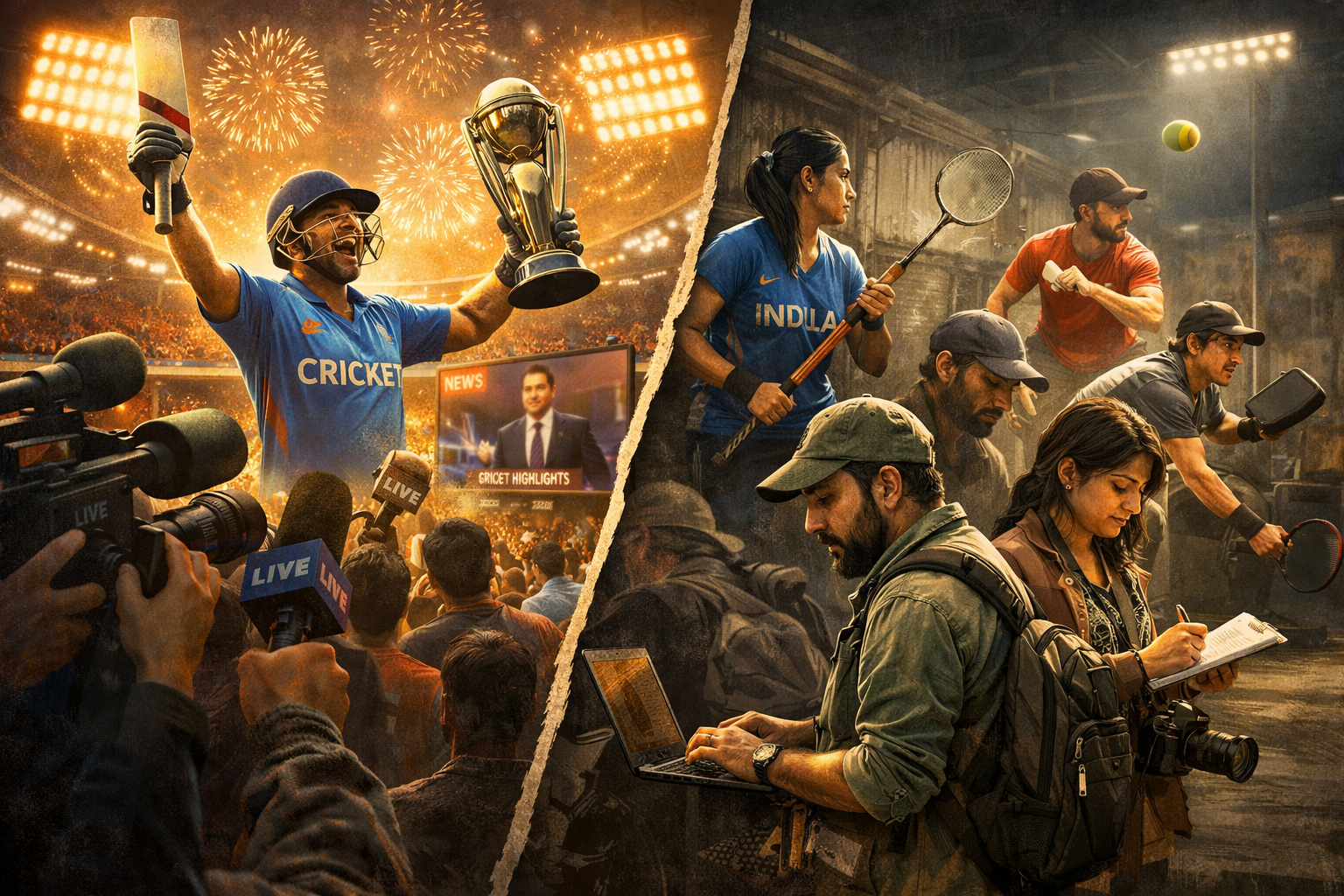

The real issue lies in the cycle of visibility. Cricket gets attention because it is popular, and it remains popular because it gets attention. Breaking this cycle requires conscious effort from all stakeholders—media, brands, and audiences—to explore and promote diverse sports narratives.
India has the talent and potential across multiple disciplines. What it needs now is a shift in focus—from a single-sport obsession to a multi-sport appreciation culture.
FAQ 2: How can non-cricket sports grow in India despite limited media coverage?
The growth of non-cricket sports in India depends on a combination of storytelling, grassroots development, and digital amplification. While traditional media may still be skewed toward cricket, the rise of digital platforms has created new opportunities for visibility.
One of the most effective ways to grow these sports is through consistent storytelling. Athletes’ journeys—especially their struggles, discipline, and breakthroughs—have the power to connect emotionally with audiences. When people relate to stories, they begin to follow the sport itself. This is how sports like badminton and kabaddi have gradually built their audience over time.
Grassroots development is equally important. Local tournaments, school-level competitions, and community-driven initiatives create a strong foundation. When participation increases at the grassroots level, it naturally leads to higher engagement and future talent development.
Digital content creators and independent journalists also play a crucial role. Today, a single viral video or well-told story can bring national attention to a lesser-known sport. Platforms like YouTube, Instagram, and LinkedIn are no longer just distribution channels—they are ecosystem builders.
Brands, too, need to adopt a long-term vision. Instead of investing only in established sports, they should identify emerging opportunities and support them early. This not only diversifies their portfolio but also helps build new sporting markets.
Ultimately, growth will come from collaboration. When media, creators, brands, and audiences work together, non-cricket sports can move from the sidelines to the spotlight.
FAQ 3: What role can individuals and content creators play in building a true sports culture in India?
Individuals and content creators are more powerful than ever in shaping the future of sports culture in India. Unlike the past, where media houses controlled narratives, today anyone with a smartphone and a platform can influence what people watch, follow, and support.
The first step is awareness. Simply choosing to engage with content beyond cricket—whether it’s liking a post, sharing a video, or following an athlete—can make a difference. Algorithms respond to user behavior, so every interaction helps increase the visibility of non-cricket sports.
Content creators, in particular, have a larger responsibility. By highlighting untold stories, covering local events, and interviewing emerging athletes, they can bridge the gap between grassroots sports and mainstream audiences. Authentic storytelling, rather than just viral content, is key to building long-term interest.
Another important role is community building. Creators can bring together niche audiences around specific sports, creating dedicated spaces for discussion, updates, and engagement. Over time, these communities evolve into strong ecosystems that support athletes and events.
Individuals can also contribute by attending local matches, supporting academies, and encouraging young athletes in their circles. Cultural change doesn’t happen overnight—it is built through small, consistent actions.
In 2026, the power to shape sports culture is no longer limited to institutions. It lies with the people. And if individuals start valuing every sport equally, India can truly transition from being a cricket-centric nation to a complete sporting powerhouse.
Related posts: