When conversations around pickleball equipment begin, paddles tend to dominate the spotlight. They are visible, customizable, and often associated with a player’s identity and style. However, serious players, coaches, and content creators understand a critical truth: the ball is just as influential—if not more—in shaping the quality and outcome of the game.
From gameplay speed to shot precision and even content production quality, the pickleball you choose can significantly alter performance. If you are aiming to play competitively or create high-quality sports content, here are five essential factors you must evaluate when selecting a pickleball.
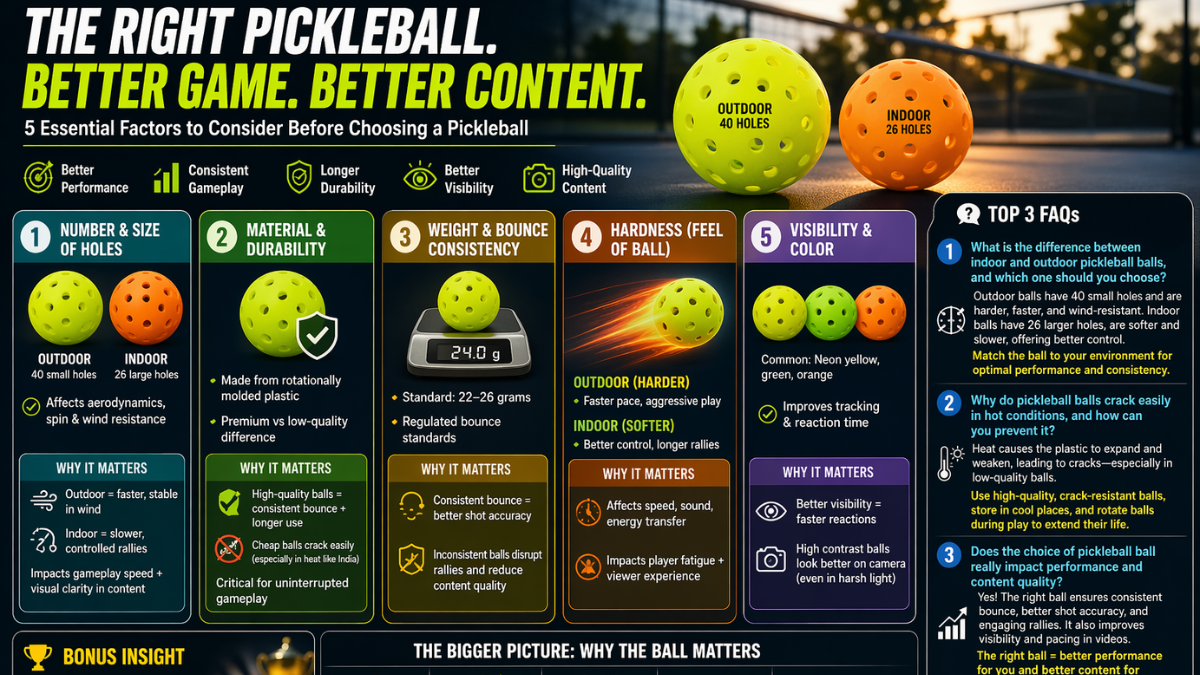

1. Number and Size of Holes:
The most fundamental differentiator between pickleball balls lies in their hole pattern—both in number and size.
• Outdoor balls typically feature 40 smaller holes
• Indoor balls generally have 26 larger holes
This design is not arbitrary. It directly impacts the ball’s aerodynamics and behavior during play.
Smaller holes in outdoor balls create a denser surface, allowing them to cut through wind more effectively. This results in a faster, more stable flight path, making them ideal for outdoor conditions where wind resistance can disrupt gameplay. On the other hand, indoor balls with larger holes generate more drag, slowing the ball down and enabling better control during rallies.
Why it matters:
The hole structure influences spin, trajectory, and responsiveness. For players, this translates into differences in timing and shot execution. For content creators, it affects how the ball appears on camera—its speed, arc, and visual clarity during rallies.
2. Material and Durability:
Most pickleball balls are made using rotationally molded plastic, but the quality of manufacturing varies significantly across brands and price points.
• Premium balls offer consistent bounce, structural integrity, and longer lifespan
• Lower-quality balls are prone to cracking, warping, or losing shape quickly
This becomes especially relevant in countries like India, where high temperatures can accelerate wear and tear. Heat exposure often leads to micro-cracks, which eventually affect bounce consistency and gameplay reliability.
Why it matters:
Durability is not just about cost efficiency—it directly impacts match quality. A cracked or deformed ball can ruin rallies, disrupt rhythm, and compromise competitive integrity.
Professional insight:
For players competing or training in hot climates, prioritizing crack-resistant balls is essential. It reduces interruptions during play and ensures consistency across longer sessions.
3. Weight and Bounce Consistency:
Pickleball balls are governed by standard specifications to maintain fairness and uniformity in competitive play.
• Weight range: Approximately 22–26 grams
• Bounce requirement: Must meet regulated drop test standards
While these standards provide a baseline, not all balls perform equally in real-world conditions. Variations in manufacturing precision can lead to inconsistent bounce behavior—even within the same batch.
Why it matters:
Consistency is everything in pickleball. Players rely on predictable bounce patterns to time their shots accurately. Even slight deviations can affect reaction time, shot placement, and overall gameplay flow.
For content creators, inconsistent bounce can make rallies look disjointed or unprofessional on camera, reducing viewer engagement and perceived quality
4. Hardness and Feel of the Ball
Another crucial factor is the ball’s hardness, which significantly influences gameplay dynamics.
• Outdoor balls: Harder construction → faster pace, aggressive play
• Indoor balls: Softer feel → better control, longer rallies
The hardness of the ball affects multiple aspects:
• Speed of play
• Sound upon contact
• Energy transfer during shots
• Physical fatigue over extended sessions
Harder balls tend to produce a sharper sound and faster rebounds, which appeals to competitive players who prefer high-intensity gameplay. Softer balls, meanwhile, allow for more controlled exchanges and are often preferred for training or recreational play.
Why it matters:
While beginners may overlook this aspect, advanced players are highly sensitive to ball feel. It directly impacts their ability to execute precise shots and maintain consistency during long rallies.
Content perspective:
The sound and speed of the ball also influence how engaging the game appears in video content. A crisp, fast-paced rally often performs better in short-form content formats.
________________________________________
5. Visibility and Color
Visibility is often underestimated, but it plays a crucial role in both gameplay and content creation.
Common pickleball colors include:
• Neon yellow
• Bright green
• Orange
These colors are chosen for maximum contrast against different backgrounds—courts, walls, and lighting conditions.
Why it matters:
Better visibility enhances reaction time, allowing players to track the ball more effectively. This is particularly important in fast-paced rallies where milliseconds matter.
For creators, visibility becomes even more critical. High-contrast balls perform better on camera, ensuring the audience can clearly follow the action. This is especially relevant in outdoor shoots under harsh sunlight or indoor environments with artificial lighting.
Bonus Insight: Tournament-Level Ball Selection
At the professional level, players often develop a preference for specific balls used in official tournaments. This is because even minor variations in performance—such as bounce height or flight stability—can influence match outcomes.
Consistency across matches is key, and using a standardized ball helps players maintain rhythm and confidence. It also ensures fairness, as all competitors are adapting to the same playing conditions.
The Bigger Picture: Why the Ball Matters More Than You Think
It is easy to treat the pickleball as a basic or interchangeable piece of equipment. However, that mindset can limit both performance and content quality.
The ball directly impacts:
• Game speed – Faster or slower rallies depending on ball type
• Shot precision – Predictable bounce enables accurate execution
• Rally length – Softer balls extend play; harder balls shorten exchanges
• Player fatigue – Ball hardness influences physical strain
• Content quality – Visibility, speed, and consistency affect viewer experience
For serious players, the ball is not just equipment—it is a performance variable. For content creators, it is a visual and storytelling tool
| Factor | Key Details | Technical Impact | Why It Matters (Player + Creator) |
| 1. Number & Size of Holes | Outdoor: 40 small holes Indoor: 26 large holes | Affects aerodynamics, spin, and wind resistance | Outdoor balls = faster, stable in wind Indoor balls = slower, controlled rallies Impacts gameplay speed + visual clarity in content |
| 2. Material & Durability | Made from rotationally molded plastic Premium vs low-quality difference | Determines lifespan, crack resistance, and shape retention | High-quality balls = consistent bounce + longer use Cheap balls crack easily (especially in heat like India) Critical for uninterrupted gameplay |
| 3. Weight & Bounce Consistency | Standard: 22–26 grams Regulated bounce standards | Controls predictability and timing of shots | Consistent bounce = better shot accuracy Inconsistent balls disrupt rallies and reduce content quality |
| 4. Hardness (Feel of Ball) | Outdoor: harder Indoor: softer | Impacts speed, sound, and energy transfer | Hard balls = fast, aggressive gameplay Soft balls = control, longer rallies Affects player fatigue + viewer experience |
| 5. Visibility & Color | Common: Neon yellow, green, orange | Improves tracking and reaction time | Better |
1. What is the difference between indoor and outdoor pickleball balls, and which one should you choose?
The primary difference between indoor and outdoor pickleball balls lies in their construction, specifically the number and size of holes, which directly impacts gameplay. Outdoor balls typically feature 40 smaller holes, making them harder and more resistant to wind. This allows for faster gameplay and greater stability in outdoor conditions. In contrast, indoor balls have 26 larger holes, resulting in a softer feel and slower pace, which enhances control and rally duration.
Choosing between the two depends largely on your playing environment and skill level. If you are playing outdoors, especially in windy conditions, outdoor balls are essential for maintaining consistency and control. Indoor balls, on the other hand, are better suited for controlled environments like indoor courts where wind is not a factor.
From a content creation perspective, outdoor balls often perform better visually due to their speed and stability, while indoor balls may offer longer rallies that are engaging for storytelling formats. Ultimately, serious players and creators should always match the ball type with the playing conditions to ensure optimal performance and consistency.
2. Why do pickleball balls crack easily in hot conditions, and how can you prevent it?
Pickleball balls are typically made from rotationally molded plastic, which, while durable under normal conditions, becomes vulnerable under extreme temperatures. In hot climates like India, prolonged exposure to heat can cause the plastic to expand and weaken, leading to cracks—especially during high-impact shots.
Cracking is one of the most common frustrations among serious players because it disrupts gameplay and increases equipment costs. Lower-quality balls are particularly susceptible, as they often lack uniform thickness and structural integrity.
To minimize this issue, players should invest in high-quality, crack-resistant balls specifically designed for outdoor and high-temperature conditions. Storing balls in a cool, shaded place when not in use can also significantly extend their lifespan. Additionally, rotating balls during play rather than using a single ball continuously can reduce stress and wear.
For professional play and content creation, maintaining ball quality is crucial. A cracked ball not only affects bounce and trajectory but also reduces the overall quality of rallies, making gameplay look inconsistent and less engaging on camera.
3. Does the choice of pickleball ball really impact performance and content quality?
Absolutely. While many beginners focus primarily on paddles, experienced players understand that the ball plays an equally important role in determining overall performance. Factors such as weight, bounce consistency, hardness, and visibility directly influence how the game is played and perceived.
A high-quality ball ensures predictable bounce, allowing players to time their shots accurately and maintain rhythm during rallies. In contrast, inconsistent balls can disrupt gameplay, leading to mistimed shots and reduced confidence. Harder balls can speed up the game, making it more aggressive, while softer balls promote control and longer rallies.
From a content creation standpoint, the ball significantly affects visual output. A ball with good visibility and consistent movement enhances the viewing experience, making rallies easier to follow and more engaging. This is especially important for social media platforms, where clarity and pace directly impact audience retention.
In competitive scenarios, even minor variations in ball performance can influence match outcomes. This is why professional players often prefer specific balls used in tournaments to maintain consistency. In essence, the right ball is not just equipment—it is a critical factor in both performance optimization and high-quality content creation.