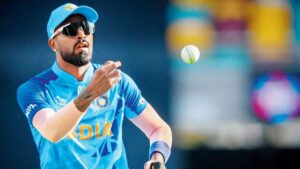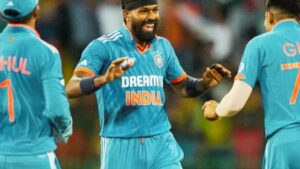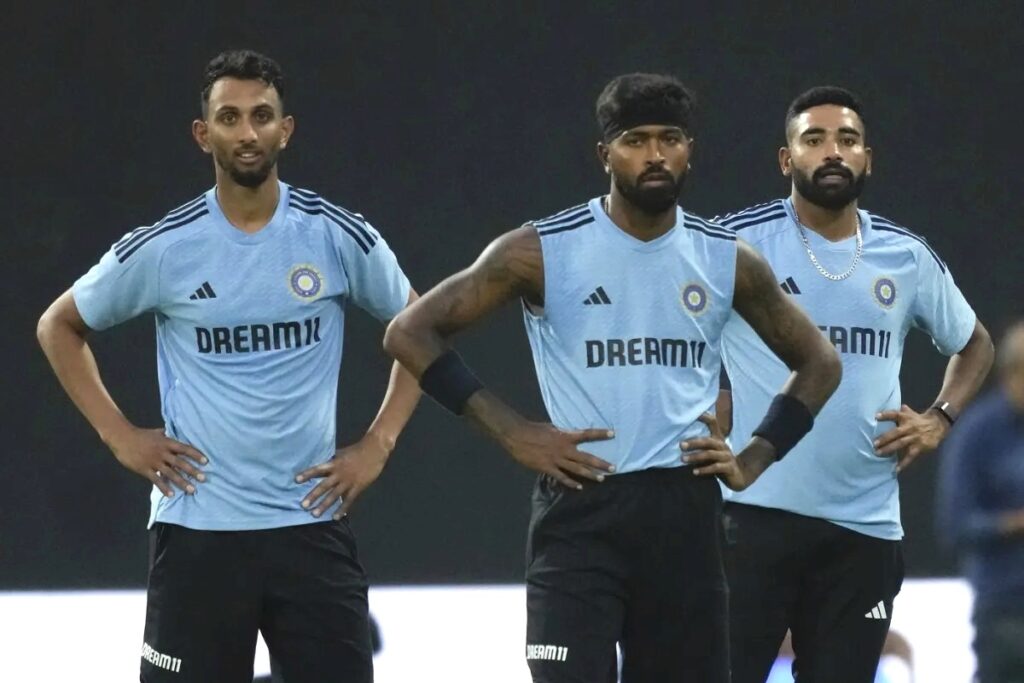
The BCCI’s Centre of Excellence (CoE) in Bengaluru is packed with activity this week, as nearly a dozen Indian cricketers Hardik Pandya, Mohammed Siraj and Ravindra Jadeja has arrive for fitness checks and recovery work ahead of next month’s Sri Lanka tour.
Who Is Already At The CoE
Several big names are already training or recovering at the facility. Hardik Pandya is working on his fitness there, while Nitish Kumar Reddy is going through recovery. Varun Chakaravarthy and Harshit Rana are both in the middle of their rehabilitation programs at the CoE. Akash Deep is also present at the facility, along with these players.
Soon, Washington Sundar will join this group, along with a few more players who are expected to arrive shortly. Test hopefuls for the Sri Lanka series have all been told to report for fitness checks before the squad gets picked.
More Players On The Way
Mohammed Siraj is expected to land at the CoE this week, and Ravindra Jadeja might join him too. Meanwhile, some targeted players like Sarfaraz Khan, Musheer Khan, and Abhishek Porel have already finished their evaluations. The CoE staff expects even more players to walk in over the coming days, right before everyone heads off to play for their zonal teams in the Duleep Trophy.
A source tracking the situation explains that the team management does not want to take chances with player fitness this time. Full checks will be done, and selectors will get clear updates on each player’s condition before the Sri Lanka squad gets picked. The source also points out that the domestic season starts soon, so even players who are not in the main squad need proper evaluation now, since there won’t be much free time once matches begin.
Fitness Worries Ahead Of A Busy Year
This heavy CoE activity comes right after reports that the Indian team is dealing with fitness troubles as it prepares for the 2027 World Cup. The team management clearly wants to avoid more injuries breaking out before or during the two important Sri Lanka Tests next month.
Most contracted players are staring at a packed calendar. There’s a long New Zealand tour coming up with five T20Is, five ODIs, and two Tests. Add to that home series against the West Indies, the Asian Games, and maybe even a Bangladesh tour before the big marquee series arrives. Because of all this, the team management wants a full pool of fit players ready to go, since different squads will need to be formed at different times.
Gill Raises Concerns Over Fitness Standards
India’s ODI and Test captain Shubman Gill spoke up about his team’s fitness levels after India lost the ODI series in England. Several players have broken down before or during matches over the past year, and this has repeatedly left the team short-handed. Gill even suggested that India might be missing something important in how it manages player fitness.
His comments have turned attention toward possible cracks in the system that connects the Indian team management with the CoE. Not too long ago, India managed to keep all its key players fit and ready for three major ICC events in 2023, 2024, and 2025. But now, some senior players appear to be finding it hard to adjust to a new system that came in after a change in staff last year. The biggest worry has been the return of hamstring injuries, again and again.
A BCCI source explains that the recent wave of hamstring injuries suggests players may not have been fully fit before stepping onto the field. There seems to be a gap in communication about player fitness and workload between the CoE and the team management. Adding to the problem, the CoE has not appointed anyone to head its medical staff since Nitin Patel left, and the standard operating procedures set up back in 2023 have not been updated since then.
Players Pushed Without A Clear Plan
During Rahul Dravid’s time as head coach, the BCCI medical team, the CoE, and the team management worked together to build year-long fitness plans for individual players. The goal was simple: get each player to peak fitness right in time for the next big ICC tournament or major Test series.
The repeated injuries suffered by Harshit Rana and Nitish Kumar Reddy have not sat well with the BCCI. Sources say Reddy has been pushed to bowl close to 140 km/h to make up for the frequently injured Hardik Pandya. Reddy worked with English bowling coach Stefan Jones to build up his pace, but that kind of speed gain needs to happen slowly and carefully when he’s with the team ahead of a big event. Instead, he keeps pushing himself to bowl faster every time he’s back with the squad.
There are also concerns about how Harshit Rana was cleared by the CoE, reportedly at the team management’s request, even though he had not returned to his pre-injury weight after a knee problem. A source noted that these situations need much more careful handling.
Jasprit Bumrah stands out as a special case for the BCCI. Even with his injury history, he is rarely pushed to bowl at high speeds months before a big tournament. His workload is increased slowly and carefully, timed to peak exactly when a major assignment arrives.
Akash Deep is another example. He had barely recovered from one injury before carrying Bengal’s pace attack through several Ranji Trophy matches. He couldn’t handle playing two Test matches back-to-back after returning from injury during last year’s IPL. He then broke down again with a hamstring problem between Tests in England last year, was cleared to play domestic cricket, played until Bengal lost the Ranji semifinal, and has been out with a stress fracture ever since. A source questioned whether the CoE is properly checking why these repeated breakdowns keep happening and whether injury prevention steps are actually being followed the right way.
Even Gill himself dealt with a hamstring issue during the recent ODI series in England, right after crossing fifty runs in two separate matches.
Players Feel Left On Their Own
Several players reportedly feel there isn’t enough communication from the BCCI’s medical team when they are away from the national side. A source explains that these days, very few players feature in all three formats. Most players get decent breaks between assignments, but if they are not doing rehab at the CoE during that time, they are largely left to manage on their own, with very little contact from the medical team.
One recent example involves Rohit Sharma’s hamstring problem during the IPL. When the Mumbai Indians management struggled for almost a month to figure out what was wrong, Rohit ended up checking his own records in the BCCI database, which had tracked his fitness data back when he played all three formats for India.
The team management is also keeping a close eye on Washington Sundar, who keeps breaking down repeatedly. Even though Reddy, Rana, and Washington are all young players, they end up spending a large chunk of their time with physios recovering from injuries rather than playing.
A source also pointed out that Sanju Samson tends to put on weight easily, calling it another sign of gaps in the fitness system. The source added that the overall standard of fielding across the team has dropped because of these ongoing fitness problems.
The source further mentioned that players need a more hands-on and caring approach from the medical team. Right now, many experienced international players are reluctant to seek help from the CoE and instead prefer training on their own elsewhere, a habit the source feels needs to be addressed soon.
Related posts: