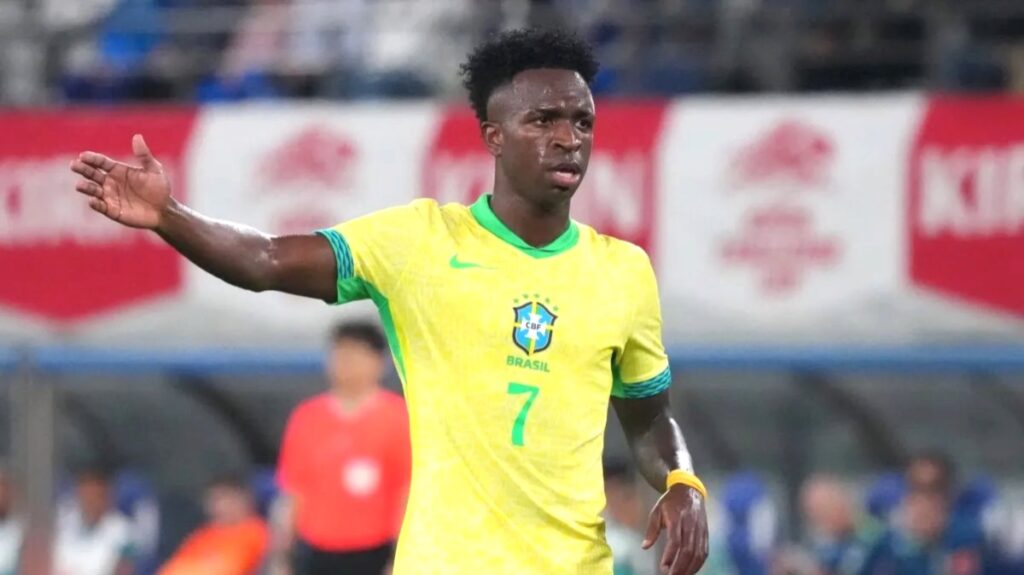
There are moments in football that stop you mid-scroll and make you pay attention. Vinícius Júnior is having a lot of those moments at the FIFA World Cup 2026. The Real Madrid forward scored twice against Scotland in Miami on Wednesday, helping Brazil to a comfortable 3-0 victory and, in doing so, wrote his name into the history books of Brazilian football.
With those two goals, Vinícius became the first Brazilian player in 24 years to score in all three group-stage matches of a single World Cup. The last time a Brazilian managed that was back in 2002, when both Ronaldo Nazário and Rivaldo did it on the way to Brazil lifting the trophy in Japan and South Korea. That is the kind of company Vinícius is now keeping, and he has earned every bit of it.
A Record 24 Years in the Making
Brazil has always had world-class forwards. The country has given football some of the sharpest, most dangerous attackers the game has ever seen. Yet, despite all that talent over the decades, only a handful of Brazilian players have ever managed to score in each of their country’s three group-stage matches at a single World Cup.
Vinícius has now joined a list that includes just four other names, Jairzinho from the legendary 1970 squad, Romário from the 1994 title-winning team, and both Ronaldo and Rivaldo from the iconic 2002 campaign. Five players in total. Five names across more than five decades of Brazilian World Cup history.
That tells you just how hard this milestone is to reach, and just how good Vinícius has been throughout this tournament’s opening phase.
How Brazil Took Apart Scotland in Miami
Brazil’s performance against Scotland was sharp, focused, and ruthless in the best possible way. The Seleção pressed high from the very first whistle, giving Scotland almost no time to settle or build any rhythm.
It took just seven minutes for Brazil to break the deadlock. Pressing Scotland deep in their own half, Brazil forced a misplaced pass from Scotland defender Scott McKenna. Vinícius read the situation perfectly, collected the loose ball inside the penalty area, and calmly guided a low finish beyond goalkeeper Angus Gunn. It was a striker’s goal, simple, composed, and deadly.
Brazil continued to control the game and, midway through the first half, Vinícius thought he had doubled the lead with another flowing move. The goal looked good, but VAR intervened, ruling it out because of a foul by Marquinhos during the build-up. It was a frustrating moment, but it didn’t shake Brazil’s grip on the game.
The second goal arrived deep into first-half stoppage time, and it was a completely different kind of finish. After Bruno Guimarães recycled possession from a partially cleared corner, he delivered a well-placed cross towards the far post. Vinícius timed his run perfectly, rose above his marker, and powered a downward header across Gunn and into the net. Two goals, two completely different types of finish, one cool and low on the ground, the other aggressive and in the air. That range is what makes him such a difficult player to defend against.
Brazil went into the break with a 2-0 lead and, in truth, the game was already done. Matheus Cunha added a third in the 60th minute to make it 3-0 and complete a very comfortable evening for the Seleção.
Neymar’s Return Added to the Evening
The win against Scotland also brought another significant moment for Brazilian football. Neymar came on as a second-half substitute, making his return from injury and appearing in a World Cup match for the first time since Brazil’s quarter-final defeat to Croatia at the 2022 tournament in Qatar.
It was a moment that completed a full evening for Brazil, a record broken, a group stage won, and a fan favourite back on the biggest stage. While Vinícius was the main story of the night, Neymar’s return added an extra layer to what was already a memorable match for the Seleção.
Vinícius’ Full Group Stage Journey
To understand just how consistent Vinícius has been, it helps to look back at all three matches together.
Brazil’s campaign started with a tough 1-1 draw against Morocco. It was not the opening result Brazil wanted, and the team needed someone to step up. Vinícius scored to earn Brazil a point and keep their tournament on track. It was not a glamorous goal in a convincing win, it was a goal that mattered, in a match where Brazil needed it most.
Next came Haiti, and Brazil were far more comfortable. Vinícius scored again and also picked up an assist in a 3-0 win. He was the driving force behind Brazil’s attack, linking up with teammates and causing problems every time he had the ball.
Then came Scotland and, with it, the two goals that made history. Across the three group games, Vinícius finished with four goals and one assist. He was involved in almost everything positive Brazil created going forward.
Four Goals and Firmly in the Golden Boot Race
Those four goals have also pushed Vinícius right into the conversation for the FIFA World Cup Golden Boot.
Lionel Messi currently leads the race with five goals after scoring twice against Austria, giving the Argentina captain a one-goal advantage heading into the knockout rounds. Right behind him, on four goals each, are Vinícius, Kylian Mbappé, and Erling Haaland, three of the most dangerous forwards in world football all level on the scoreboard.
The Golden Boot race at this World Cup has the kind of lineup that feels almost too good to be true. Messi chasing one last piece of glory. Mbappé, the reigning world champion, hunting goals at his peak. Haaland, the Premier League’s most feared finisher, on the biggest stage of all. And now Vinícius, fresh off a historic group stage, right there with all of them.
For Vinícius personally, those four goals also moved his overall international tally to 13 goals in 52 appearances for Brazil. That number will only grow as the tournament continues.
What Makes Vinícius So Hard to Stop
There is no single way that Vinícius scores his goals, and that is exactly what makes him so difficult to plan against. Against Scotland, he showed two completely different sides of his game in the same match.
His first goal was all about intelligence and movement. He pressed the defender, anticipated the mistake, stayed calm inside the box, and picked his spot. It was the kind of goal that looks simple but requires a very specific mindset, to keep pressing even when you are already in a comfortable position, and to finish cleanly when the chance arrives.
His second goal was almost the opposite. It required physical work, timing a run into the box, getting above his marker in the air, and then redirecting a powerful header into a corner that the goalkeeper couldn’t reach. Headers are not always the first thing people associate with Vinícius, which is exactly what made it so effective.
Across his three group games, he scored with his left foot, his right foot, and his head. He scored in open play from a press, from a counterattack, and from a set piece situation. Defenders at this tournament will have no easy answer for him.
Brazil Finish the Group Stage Unbeaten
Beyond the individual records, Brazil also completed their group stage in strong shape as a team. They finished Group C in first place with seven points, one draw and two wins, with seven goals scored and just one conceded across three matches.
That one conceded goal came in the draw against Morocco, which was the only moment in three games where Brazil looked anything less than fully in control. After that, they put together back-to-back 3-0 wins with clean sheets, finishing the group stage with momentum behind them and the squad largely fit and available.
Carlo Ancelotti has built this Brazil team around Vinícius as the main attacking threat, and through three group games, that plan has worked almost perfectly. The forward has delivered in every single match, and the team’s results have followed.
The Exclusive Club Vinícius Has Joined
It is worth taking a moment to think about the names on that list again, Jairzinho, Romário, Ronaldo, Rivaldo, and now Vinícius.
Jairzinho’s 1970 Brazil team is still regarded by many as the greatest international football team ever assembled. Romário was the tournament’s best player in 1994 and one of the sharpest finishers the sport has ever produced. Ronaldo in 2002 finished as the Golden Boot winner and Player of the Tournament, scoring eight goals on the way to Brazil’s fifth World Cup title. Rivaldo in that same tournament was equally brilliant, his performances throughout the group stage and knockouts helping Brazil dominate the competition.
These are not just good players. They are players that football still talks about decades later. And Vinícius, at this World Cup, has done something none of the Brazilian forwards who came between 2002 and now managed to do.
He has been on the scoresheet in every single group game. He has been consistent when it counted. He has carried his club form, one of the best players in Europe season after season at Real Madrid, onto the international stage in a tournament that matters most.
Brazil are through to the Round of 32 as group winners. Vinícius has four goals, a place in history, and a Golden Boot race that is very much alive. The group stage is done, and one of its biggest stories has undoubtedly been a 25-year-old Brazilian winger making history one goal at a time.