Everything You Need to Know About Pickleball Indoor vs Outdoor Balls (Specifications, Weight & Materials)
If you’re serious about playing, coaching, or building infrastructure in India, understanding the difference between indoor and outdoor pickleball balls is essential.
At first glance, both balls may look identical — same size, same bright color, same wiffle-style holes. But in reality, their construction, performance behavior, and material composition are very different. Choosing the wrong one can completely alter the quality of play.
Here’s a detailed breakdown 👇
1. 𝓞𝓾𝓽𝓭𝓸𝓸𝓻 𝓟𝓲𝓬𝓴𝓵𝓮𝓫𝓪𝓵𝓵 𝓑𝓪𝓵𝓵𝓼
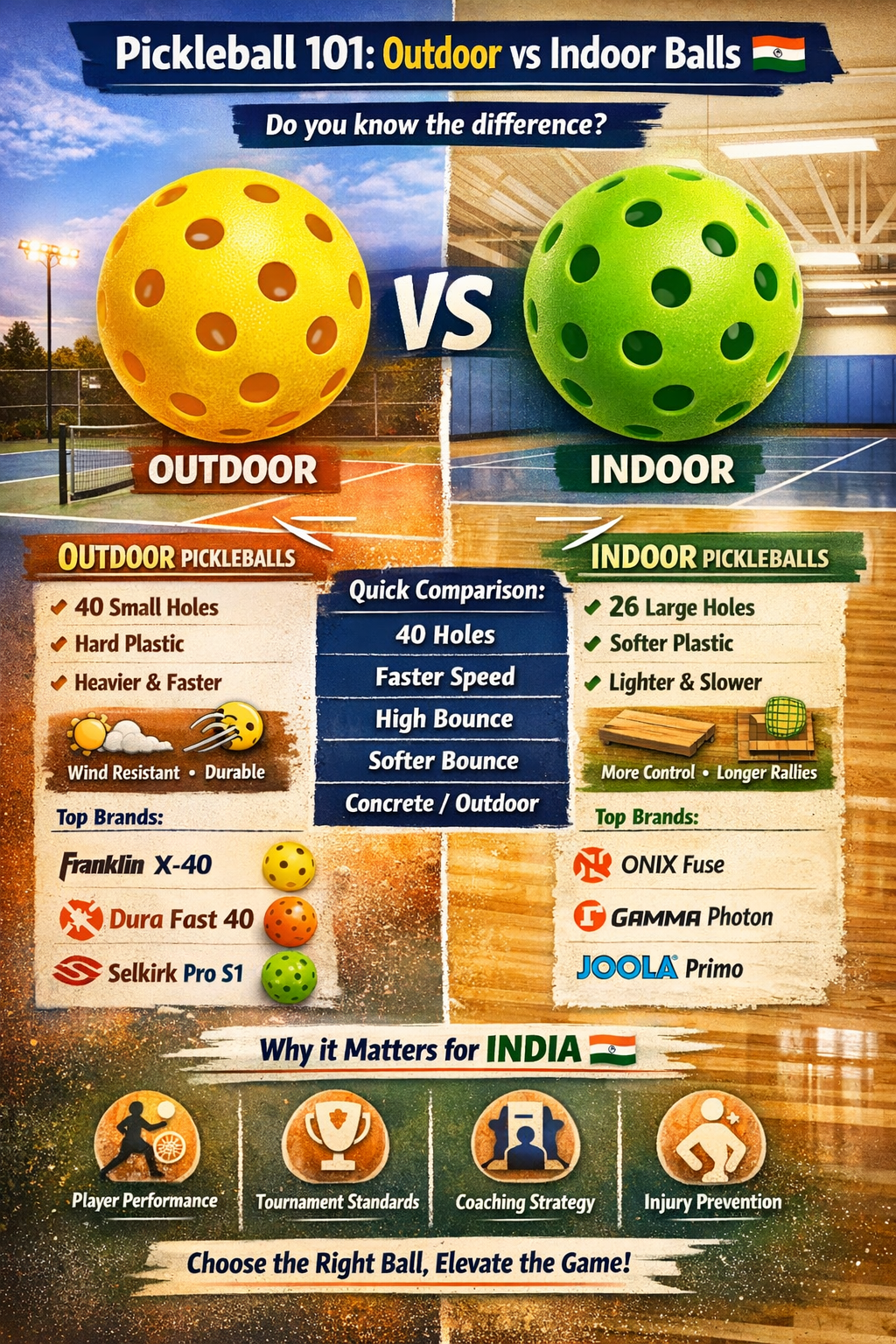
Outdoor pickleball balls are the most commonly used in India because most courts are open-air and built on acrylic or concrete surfaces. These balls are specifically engineered to withstand wind, sun exposure, and rough playing conditions.
Specifications:
Weight: 25–26 grams
Diameter: 73–74 mm
Number of Holes: 40 (smaller holes)
Material: Hard, rotationally molded plastic (typically polyethylene)
Key Features:
Hard plastic construction
40 smaller holes
Slightly heavier than indoor balls
Designed to handle wind resistance
More durable against cracking on hard surfaces

The plastic used in outdoor balls is firmer and denser. This helps maintain structural integrity when hitting rough courts repeatedly. Because outdoor courts in India are often exposed to high temperatures, durability becomes even more important.
Why 40 Holes?
The 40 smaller holes are not random — they serve a specific aerodynamic purpose.
Smaller holes:
Reduce wind interference
Provide better directional stability
Minimize unpredictable drifting
Since outdoor courts are subject to environmental variables like crosswinds, smaller holes help the ball travel in a straighter, more stable path.
Playing Characteristics
Outdoor rallies are generally faster because:
The ball is harder
The bounce is sharper
Speed off the paddle is higher
Players often experience a more aggressive pace during outdoor games. Power hitters tend to enjoy outdoor play because the ball responds quickly and maintains speed through rallies.
Popular Outdoor Ball Brands
Franklin Sports X-40
Onix Sports Dura Fast 40
Selkirk Sport Pro S1
These balls are widely used in professional-level tournaments globally and are known for consistency and durability.
2. Indoor Pickleball Balls:
Indoor balls are designed for controlled environments — wooden gym floors or synthetic indoor courts. Since there is no wind factor indoors, the ball construction focuses more on control and softer play.
Specifications:
Weight: 24–25 grams
Diameter: 73–74 mm
Number of Holes: 26 (larger holes)
Material: Softer, flexible plastic
Key Features:
Softer plastic construction
26 larger holes
Slightly lighter than outdoor balls
Designed for controlled rallies
Reduced impact on indoor surfaces
The softer plastic reduces noise and impact, making it suitable for indoor halls and community sports complexes.
Why 26 Holes?
Indoor balls have 26 larger holes to regulate airflow differently.
Larger holes:
Reduce bounce speed
Slow down ball travel
Increase control
Because there is no wind indoors, the ball doesn’t need aerodynamic stabilization. Instead, it is optimized for longer rallies and strategic gameplay.
Playing Characteristics
Indoor games typically:
Have longer rallies
Offer more control
Feel softer on paddle contact
The slightly lighter weight and softer plastic make the ball easier to manage, especially for beginners and technical players who prefer placement over power.
Popular Indoor Ball Brands
Onix Sports Fuse Indoor
Gamma Sports Photon Indoor
Joola Primo Indoor
These balls are commonly used in indoor leagues and recreational tournaments.
Material Science Behind the Difference
Both indoor and outdoor balls are made from plastic polymers, but the hardness level differs. Outdoor balls use a more rigid plastic blend to withstand surface abrasion. Indoor balls use a slightly softer formulation to reduce cracking and noise.
Temperature also impacts performance. Outdoor balls can become brittle in cold weather and softer in extreme heat. Indoor balls remain more stable because environmental conditions are controlled.
This is why serious tournaments specify the exact ball model before competition — consistency matters.
Are Pickleball Balls Interchangeable?
Short answer: No.
👉 Playing outdoor with an indoor ball? It may drift unpredictably due to wind and crack faster on rough surfaces.
👉 Playing indoor with an outdoor ball? It may feel too hard, bounce too sharply, and reduce rally control.
Using the wrong ball affects:
Player timing
Shot selection
Injury risk
Coaching development
Why This Matters for India
India’s pickleball ecosystem is growing rapidly. New academies, clubs, and leagues are emerging across metropolitan cities and tier-two towns. However, many new setups overlook technical details like ball selection.
For infrastructure developers, using the correct ball type improves:
Professional credibility
Player satisfaction
Tournament standardization
For coaches, the right ball ensures consistent training conditions.
Small technical decisions shape the long-term development of the sport.
Final Take
Pickleball balls may look similar, but their design, weight, hole configuration, and material composition create completely different playing experiences.
Outdoor balls are built for durability and speed.
Indoor balls are built for control and consistency.
The right ball equals better game quality.
As India continues building its pickleball ecosystem, understanding such technical nuances will separate casual recreational setups from serious sporting infrastructure.
If you found this insightful, let’s continue the conversation and contribute to building a smarter pickleball community in India.
Indoor vs Outdoor Pickleball Balls – Complete Comparison
| Category | Outdoor Pickleball Balls | Indoor Pickleball Balls |
|---|---|---|
| Primary Usage | Open-air courts (acrylic, concrete) | Wooden gym floors, synthetic indoor courts |
| Weight | 25–26 grams | 24–25 grams |
| Diameter | 73–74 mm | 73–74 mm |
| Number of Holes | 40 (smaller holes) | 26 (larger holes) |
| Hole Purpose | Aerodynamic stability in wind | Slower, controlled airflow indoors |
| Material | Hard, rotationally molded plastic (polyethylene) | Softer, flexible plastic polymer |
| Durability Level | High – built for rough surfaces & heat | Moderate – built for controlled surfaces |
| Bounce Profile | Sharper, faster bounce | Softer, controlled bounce |
| Game Speed | Faster rallies | Slower, longer rallies |
| Feel on Paddle | Hard contact feel | Softer contact feel |
| Wind Resistance | Designed to reduce drifting | Not wind-optimized |
| Temperature Sensitivity | Can become brittle in cold, softer in extreme heat | More stable due to indoor climate |
| Best For | Power hitters, aggressive gameplay | Technical players, controlled placement |
| Noise Level | Louder impact sound | Reduced noise impact |
| Injury Risk Factor | Higher impact on joints if used indoors | Lower impact in controlled setting |
🔬 Aerodynamic & Structural Difference
| Feature | Outdoor Ball Design | Indoor Ball Design |
|---|---|---|
| Hole Size | Smaller | Larger |
| Hole Count | 40 | 26 |
| Purpose | Minimize wind interference & drifting | Regulate airflow for control |
| Structural Density | Denser & firmer | Slightly softer & flexible |
🌍 Popular Ball Models
| Category | Ball Model | Brand |
|---|---|---|
| Outdoor | X-40 | Franklin Sports |
| Outdoor | Dura Fast 40 | Onix Sports |
| Outdoor | Pro S1 | Selkirk Sport |
| Indoor | Fuse Indoor | Onix Sports |
| Indoor | Photon Indoor | Gamma Sports |
| Indoor | Primo Indoor | Joola |
Are They Interchangeable?
| Scenario | What Happens |
|---|---|
| Using Indoor Ball Outdoors | Unstable flight in wind, cracks faster on rough surfaces |
| Using Outdoor Ball Indoors | Feels too hard, sharper bounce, reduced rally control |
| Impact on Coaching | Inconsistent timing & shot selection |
| Impact on Infrastructure | Reduced professional credibility |
Why This Matters for India
| Stakeholder | Importance of Correct Ball Selection |
|---|---|
| Academies | Ensures proper skill development |
| Tournament Organizers | Maintains standardization |
| Infrastructure Developers | Enhances professional credibility |
| Coaches | Creates consistent training environment |
| Players | Improves performance & reduces injury risk |
Final Summary
| Outdoor Balls | Indoor Balls |
|---|---|
| Built for durability & speed | Built for control & consistency |
| Harder plastic | Softer plastic |
| 40 smaller holes | 26 larger holes |
| Faster gameplay | Longer rallies |