Can Pickleball Become the Next Gully Cricket in India? Let’s Decode with Facts
India is a country where sports are not just games — they are emotions. Among them, gully cricket holds a special place. From narrow streets to open parks, from small towns to metro cities, cricket has grown because it is simple, affordable, and accessible.
Now a new question is rising:
Can pickleball become the next gully cricket in India?
The short answer is — yes, it can. But it will take time, awareness, and grassroots growth.
Let’s break it down with facts.
Why Gully Cricket Became So Big
To understand pickleball’s potential, we must first understand why gully cricket became so popular.
Gully cricket requires very little:
A bat
A ball
A few friends
Any open space
It doesn’t need professional grounds or expensive equipment. Children play in streets, parks, terraces, and small grounds. The rules are flexible. The game is social. It connects neighbors and friends.
Most importantly, cricket is deeply connected to Indian culture. From watching international matches to playing local tournaments, cricket is a shared national experience.
For pickleball to become the next gully cricket, it must follow a similar path — simplicity, affordability, and accessibility.
What Makes Pickleball Different — And Powerful
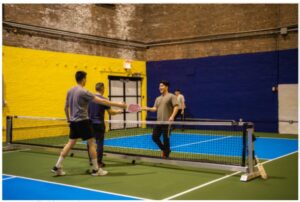
Pickleball is simple and easy to learn. It combines elements of tennis, badminton, and table tennis, but it is less physically demanding compared to many racket sports.
Here are some key advantages:
It does not require a large playing area.
It can be played indoors or outdoors.
It is suitable for all age groups.
The learning curve is short.
Unlike cricket, where large open spaces are ideal, pickleball needs a marked court. But the advantage is that the court size is small.
In fact, a pickleball court is almost one-fourth the size of a tennis court. This means more courts can be built in less space — especially in housing societies, schools, and clubs.
In a country where space is limited in urban areas, this becomes a major advantage.
Growth Stats That Show Its Potential
Let’s look at the numbers that show why pickleball is not just a trend, but a growing movement.
• Pickleball is played in 60+ countries worldwide.
• It has been one of the fastest-growing sports globally in the last 3–4 years.
• In India, the number of pickleball courts has grown rapidly in metro cities like Mumbai, Delhi, Bengaluru, and Hyderabad.
This shows that the sport is already gaining attention in urban India.
Another important factor is cost.
Compared to tennis, pickleball equipment is more affordable. A beginner can buy a basic paddle and ball set at a reasonable price. For middle-class families and communities, this makes the sport more accessible.
Lower cost + smaller space requirement = strong foundation for mass adoption.
The Biggest Strength: All Age Groups Can Play
One of the biggest advantages of pickleball is inclusivity.
Children can play it.
Working professionals can play it after office hours.
Senior citizens can also enjoy it without heavy physical strain.
Very few sports in India offer this kind of cross-generational appeal.
Cricket in gullies is mostly youth-driven. Pickleball, on the other hand, can become a family sport. Imagine housing societies where kids, parents, and grandparents all play together.
That social bonding factor can become a major growth engine.
The Real Challenges
However, the journey is not easy.
There are some clear challenges:
Low Awareness
Many people in India still don’t know what pickleball is. Compared to cricket, football, or badminton, awareness is very limited.
Limited Courts and Infrastructure
While courts are increasing in metro cities, they are still scarce in Tier-2 and Tier-3 cities.
Cultural Dominance of Cricket
Cricket is not just a sport in India — it is an emotion. It is part of childhood memories, festivals, and national pride. Replacing that emotional connection is extremely difficult.
Because of this, pickleball may not “replace” gully cricket — but it can grow alongside it.
What Needs to Happen for Mass Growth?
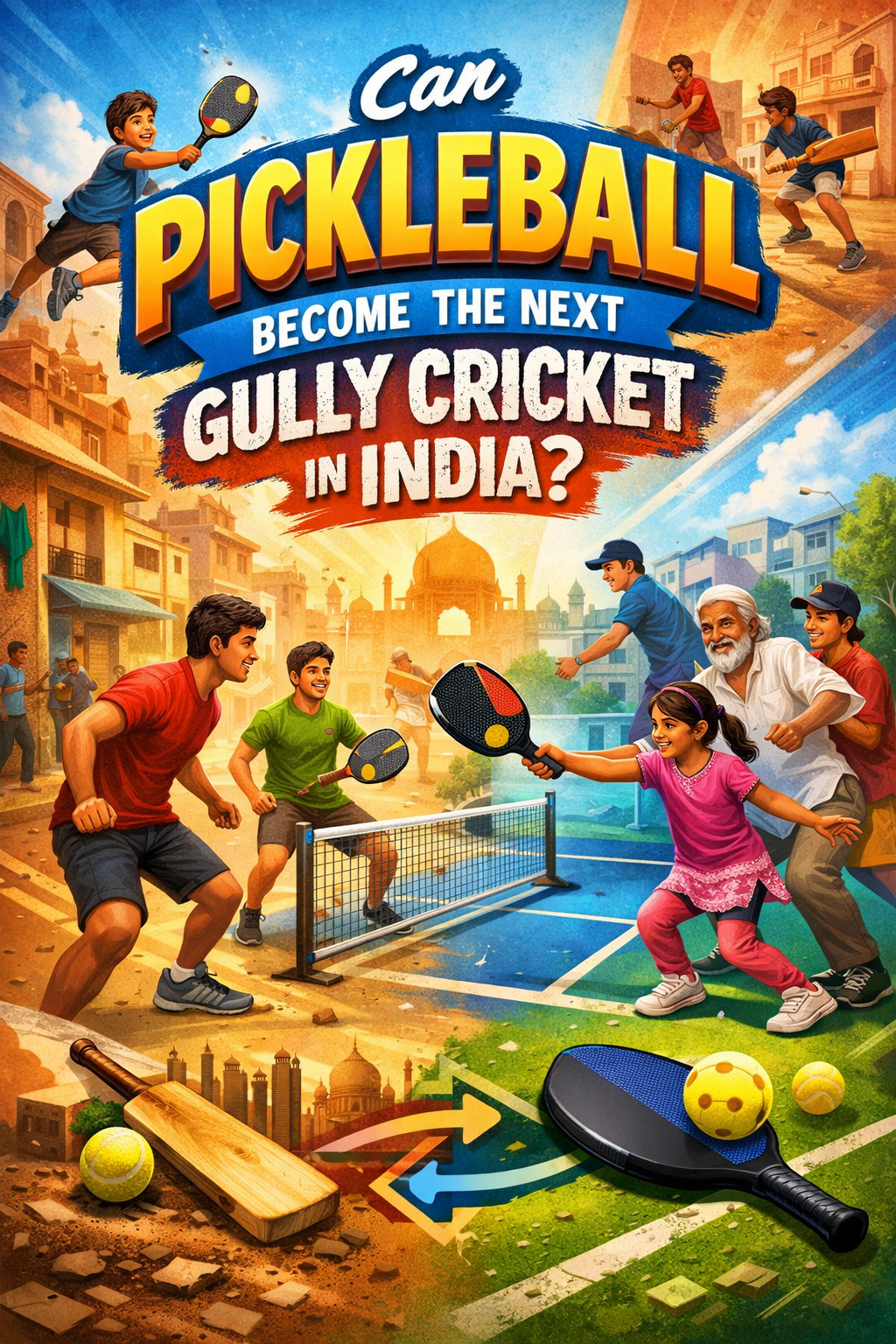

For pickleball to become like gully cricket, the growth must start at the grassroots level.
Here’s what can accelerate its journey:
1. Schools Should Introduce It
If schools include pickleball in physical education programs, children will learn it early. Early exposure builds long-term players.
2. Housing Societies Should Build Courts
Since the court size is small, societies can convert unused areas into pickleball courts. Once people see others playing, curiosity turns into participation.
3. Community Tournaments
Local tournaments create excitement and competitive spirit. This builds visibility and social acceptance.
4. Influencers and Athletes Promotion
When public figures and sports personalities promote a sport, awareness spreads faster.
Can It Truly Become the “Next Gully Cricket”?
The realistic answer is this:
Pickleball has the infrastructure advantage (small court).
It has the cost advantage (affordable equipment).
It has the age advantage (all generations can play).
It has the global momentum advantage (fast-growing worldwide).
But it does not yet have the emotional advantage that cricket has in India.
That emotional connection will take years to build.
If pickleball becomes easily available in schools and societies, and if more people start playing regularly, it can grow at a very fast pace.
Maybe it will not replace gully cricket — but it can definitely become a parallel mass sport in urban India.
Final Verdict
Yes, pickleball has the potential to become like gully cricket in India.
But growth will depend on:
Accessibility
Awareness
Community adoption
Grassroots promotion
The opportunity is real. The ingredients are there. The execution will decide the future.
India is ready for new sports culture. The only question is — how fast can pickleball reach every neighborhood?
| Section | Details |
|---|---|
| Main Question | Can Pickleball Become the Next Gully Cricket in India? |
| Short Answer | Yes, but it will take time, awareness, and grassroots growth. |
Why Gully Cricket Became Popular
| Factor | Explanation |
|---|---|
| Simplicity | Easy rules, flexible format |
| Low Cost | Only bat and ball required |
| Accessibility | Can be played in streets, parks, terraces |
| Cultural Connection | Deep emotional attachment in India |
| Social Nature | Builds neighborhood bonding |
Pickleball’s Key Advantages
| Factor | Explanation |
|---|---|
| Easy to Learn | Simple rules, short learning curve |
| Smaller Court | Requires only 1/4th space of a tennis court |
| Indoor/Outdoor Play | Can be played in multiple settings |
| Affordable Equipment | Paddle + ball set cheaper than tennis |
| Multi-Age Appeal | Suitable for kids, adults, senior citizens |
Important Growth Stats
| Statistic | Details |
|---|---|
| Global Presence | Played in 60+ countries |
| Growth Rate | Among fastest-growing sports globally in last 3–4 years |
| Indian Expansion | Courts growing rapidly in Mumbai, Delhi, Bengaluru, Hyderabad |
| Space Efficiency | 1 tennis court = approx. 4 pickleball courts |
| Cost Advantage | Lower entry cost compared to tennis |
Major Strengths of Pickleball
| Strength | Impact |
|---|---|
| Inclusive Sport | All age groups can participate |
| Social Sport | Encourages family and community bonding |
| Urban Friendly | Suitable for limited space in cities |
| Less Physically Demanding | Accessible to beginners and seniors |
Key Challenges
| Challenge | Explanation |
|---|---|
| Low Awareness | Many Indians still unfamiliar with the sport |
| Limited Infrastructure | Courts mainly in metro cities |
| Cricket Dominance | Strong emotional and cultural connection to cricket |
| Grassroots Gap | Limited school-level integration |
What Needs to Happen for Growth
| Action Required | Expected Result |
|---|---|
| Introduce in Schools | Early adoption among children |
| Build Courts in Societies | Increased local participation |
| Organize Community Tournaments | Visibility and excitement |
| Influencer & Athlete Promotion | Faster awareness growth |
| Affordable Equipment Availability | Wider accessibility |
Final Verdict
| Conclusion | Explanation |
|---|---|
| High Potential | Strong global growth and urban suitability |
| Needs Time | Cultural shift takes years |
| Grassroots Key | Schools & societies will drive mass adoption |
| Future Outlook | Can become a parallel mass sport alongside gully cricket |
Overall Summary
| Category | Pickleball Status in India |
|---|---|
| Accessibility | Growing but limited |
| Awareness | Moderate in metros, low elsewhere |
| Affordability | High |
| Cultural Connect | Developing |
| Growth Potential | Very High |
Related posts: