Bhuvneshwar Kumar didn’t plan any of this. Not the swing, not the bouncer, not the wobble seam that made Sachin Tendulkar stop a video and think hard about seam angles in 2026. He just kept showing up, kept bowling, and kept filing mental notes he never once wrote down.
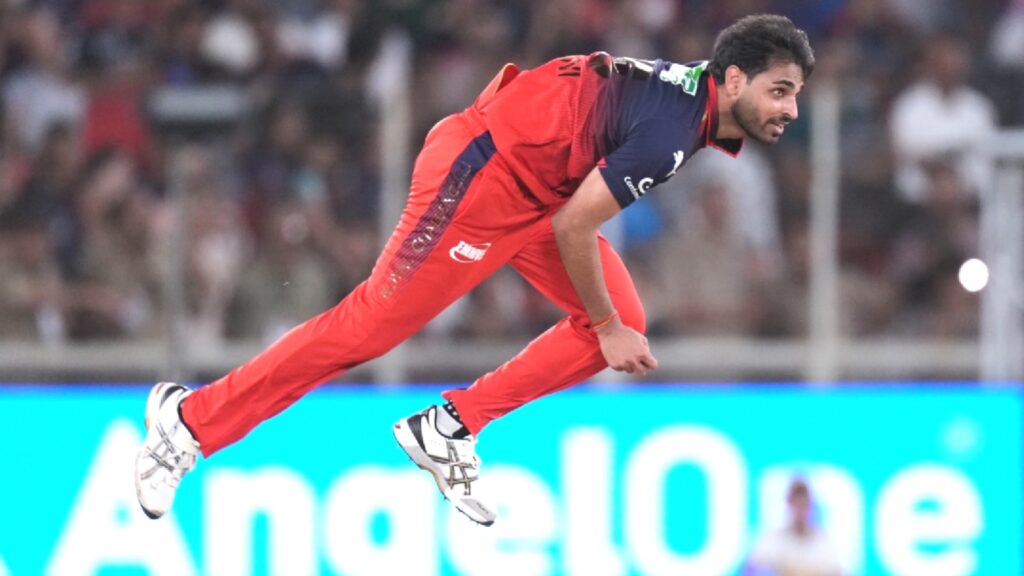
At 36, Bhuvneshwar Kumar is the only bowler in IPL history to win back-to-back Purple Caps. In IPL 2026, he helped Royal Challengers Bengaluru reach the final, where he watched Josh Hazlewood bowl a bouncer, stored it in his memory mid-match, and used it three overs later to take a wicket. That is who Bhuvneshwar Kumar is. A bowler who is always watching, always collecting, and never finished learning.
But to understand how Bhuvneshwar Kumar became one of the smartest bowlers in Indian cricket, you have to go back to Meerut. To a 14-year-old boy with a bowling action that went wrong.
The Action That Went Wrong and Started Everything
When Bhuvneshwar Kumar first bowled in the nets as a young boy in Meerut, the coaches told him the ball was swinging. He didn’t think much of it. The other kids swung it too. He had no idea his hands were doing something unusual until coaches kept pointing it out, and even then it only started to make sense when he was playing under-17 cricket.
“I was mainly an inswinger when I started playing cricket,” Bhuvneshwar says. “Some part of the action changed, think I must have been around 15-16 perhaps. And I started outswinging.”
Most cricketers spend their entire careers trying to stop their action from changing. Bhuvneshwar Kumar’s career was built on a change he didn’t even notice happening. The outswinger, the delivery that would eventually put his name on the Lord’s honours board, came from something he didn’t plan and couldn’t fully explain.
“No one taught me how to swing on both sides,” he says. “It was my luck that some action went wrong, but luckily I understood how to swing on both sides.”
His coaches in Meerut were Vipin Vats and Sanjay Rastogi. Vats also coached Praveen Kumar. Bhuvneshwar says he was lucky to have them. Back home after training, the young Bhuvneshwar would come back so tired that he couldn’t even eat by himself. His mother gave his elder sister the daily job of feeding him as he lay on the bed, half asleep. In Meerut, they have a word for a man like this, karmath. Someone who believes in the work, not the stories around it.
The Night He Dreamed of Tendulkar’s Wicket
In January 2009, Bhuvneshwar Kumar was 18 years old and about to bowl at Sachin Tendulkar in the Ranji Trophy. Uttar Pradesh vs Mumbai. The night before, he dreamed about taking Tendulkar’s wicket. The UP team manager, Ashish Zaidi, found him and gave him simple advice, Tendulkar isn’t going to take your life. Worst case, six sixes. Fix a spot and bowl there.
On his 14th delivery to Tendulkar, Bhuvneshwar bowled full. The seam moved through the air, swung in late, kissed the edge, onto the pad, and popped up to short midwicket. Tendulkar’s first duck in Indian domestic cricket. Bhuvneshwar’s phone didn’t stop ringing for two hours.
Seventeen years later, his bowling philosophy is exactly the same. Fix a spot. Bowl there. Don’t try anything special. The words around it have changed, gut feeling, wobble seam, body control, mental notes, but the idea at the centre has not moved.
Learning the Bouncer From Other People’s Surprise
Cricket has a simple rule about medium-pace bowlers and bouncers: if you bowl at 130 kilometres an hour, the batsman sees it early, picks the length, gets into position, and hits it out of the ground. Bhuvneshwar Kumar knew this rule. He accepted it, at first.
“Initially, there was no confidence,” he says. “Because it’s low pace, you bowl a bouncer, it’s a six.”
But he kept trying it in practice anyway. Putting in extra effort on the delivery to see what came out. “Once or twice, it was fast. Then slowly I understood how to control the body.” He started doing it on purpose in practice. Then it became a habit.
The strange part is how he found out it was working. Not from his own assessment. From his seniors in the Ranji Trophy. “Someone said, your bouncer is fast. I thought, I don’t know why he is saying that. Even I don’t know. But slowly the seniors say that the bouncer is fast, then someone says, maybe that’s why. Then slowly you understand things.”
Bhuvneshwar Kumar reverse-engineered his own weapon from other people’s surprise at it. He used it to dismiss Babar Azam in international cricket, after a full outswinger was driven to the long-off boundary, he followed it with a short, sharp bouncer and a startled Babar sent a catch to short fine-leg.
In the IPL 2026 final against Gujarat Titans, he was watching Josh Hazlewood from the other end. Hazlewood bowled a bouncer to Sai Sudharsan. Sudharsan went to pull and the ball just dropped awkwardly on him. Bhuvneshwar watched it, stored it, and a few overs later used the same delivery to take Sudharsan’s wicket. “I was watching and suddenly I was reminded that yes, this can also work. So that, it was about watching things.”
Lord’s, Johannesburg, and the Memory of Eden Gardens
July 2014. Lord’s Test. Bhuvneshwar Kumar took six wickets in an innings, Alastair Cook, Sam Robson, Gary Ballance, Ian Bell, Ben Stokes. His name went on the Lord’s honours board, only the third Indian to take six wickets there after Amar Singh in 1936 and Bishan Bedi in 1974. A family friend in the UK sent him a photo of the board with his name on it. He talks about it the way someone talks about a thing they’re glad exists, not something they need to wave around.
January 2018. Wanderers, Johannesburg. Third Test against South Africa. AB de Villiers came in at 88 for 3. Over the next 19 balls, Bhuvneshwar bowled him a long, careful sequence of outswingers. Nothing to drive, nothing to flick, just balls starting at sixth stump and moving further away. De Villiers played with soft hands. Edges didn’t carry. He shouldered arms. Five runs off 14 balls.
“I had in mind that the more I delay putting in the inswing, sometimes if you give the batsman a few outswings, unknowing, even after knowing it, he starts moving towards the ball. Technically.”
At 36.4 overs, Bhuvneshwar bowled full. It started at sixth stump. Late inswing. De Villiers was already leaning towards where the outswinger should have been. The ball went the other way, brushed the back leg, and took out middle stump. “I knew which line to put it in.” The commentators just said: wow.
But the match Bhuvneshwar Kumar remembers most is not Johannesburg. It is Eden Gardens, 2017, against Sri Lanka.
“Not a particular ball,” he says. “But as a bowler if I say a Test match which I like a lot, that was against Sri Lanka in India. Eden Gardens in 2017. Where I got 4-4 wickets in the first and second innings. 8 wickets. I enjoyed that a lot. Even now when I remember it, I feel good. It’s not because of any particular wicket. It’s just the full match. The way I got the wickets there, on swing.”
India needed to bowl Sri Lanka out inside a session in the second innings, chasing 231. Bhuvneshwar took the first wicket in the very first over, then four wickets for 8 runs across 11 overs, 8 of them maidens. The ball started reversing late, which he hadn’t planned but recognised and used. Bad light saved Sri Lanka at 75 for 7. He was Player of the Match.
He cannot name a single wicket from that day. Johannesburg he remembers ball by ball. Eden Gardens he remembers as a feeling. The difference isn’t about which one was bigger. It’s just about what the memory holds.
The Wobble Seam: 15 Years of Removing the Signal
The wobble seam delivery that Sachin Tendulkar stopped to analyse on social media in 2026 is not a new invention. Bhuvneshwar Kumar has been working on it since before Covid. But not consistently. Not with full conviction. The conviction came the way everything has come for him, slowly, through experience piling up until it becomes something he can trust.
The old coaching instruction was the opposite of what he does now: put it on the seam and something will happen. That was true when the quality of the ball was good enough to swing on its own. “The quality of the ball was so good, that if you put it in the air, it will swing,” he says. “But as the quality of the ball has reduced, things evolve.”
The wobble seam is that evolution. A delivery built for a world where the ball no longer behaves the way it used to.
The mechanics are simple. The ball should not land on the seam. That is the whole point. “The main objective is the ball should not be landing on the seam. That’s a simple thing.” When it doesn’t land on the seam, it can go anywhere. And Bhuvneshwar doesn’t try to aim it. “No, just normally, normally. You don’t even want to do that. Because you also don’t know where the ball is going to go, that’s the thing.”
For the last two or three years, he has been bowling this delivery much more often, studying which batsmen it works against most, in which situations, at what stage of an innings. In IPL 2026, he also brought Test-match thinking into T20 cricket. “In T20, technical things matter a lot to the batsman. To hit a six, you have to be technically sound. If you are not technically sound, then very basic things like the shoulder opening, I tried to exploit that this year.”
Tendulkar watched all of it and named it publicly. Bhuvneshwar agreed, acknowledged it, and moved on.
A batsman reads the signal in a delivery and plays accordingly. For 15 years, Bhuvneshwar Kumar has been working to remove the signal entirely. The outswinger told you something and then arrived somewhere else. The wobble seam tells you nothing at all.
On Vaibhav Sooryavanshi and What’s Already Been Done
While the cricket world in June 2026 is completely focused on 15-year-old Vaibhav Sooryavanshi, the boy who broke Sachin Tendulkar’s 36-year record as the youngest player selected for the Indian senior team, after finishing IPL 2026 as its highest run-scorer, Bhuvneshwar Kumar has a quiet take on the teenager he bowled a knuckleball to in 2025.
“He gets into nice shape and position. Sometimes even if he is not in position, his bat speed is so fast, he manages with that. So I think this guy is special. I don’t know what’s written for him, but if everything goes well, he will break and make many records.”
On his own possible return to the Indian team, after two IPL Purple Caps, more and more people are bringing it up, Bhuvneshwar Kumar doesn’t play along with the drama of it.
“It’s my nature that I don’t want to show that I want to play. I think everyone is doing their job. Selectors are doing their job. I’m doing my job. It’s their responsibility to select. If they think I’m good enough, they will do their job.”
When pushed, he admits he wants to play for India. He just won’t perform the wanting. “I have played, I have done what I had to do. If I hadn’t played, I would have been dying to be asked to play a match.”
There is no advice, he says, that has changed his life or transformed his bowling. “Bowling is not that simple, you have to work hard for it.” What he controls is the preparation, a trainer, a physio, a dietitian, a schedule that runs through the off-season with or without a tournament coming up.
The mental notes stay in his head. No notebook, no system. Just things he has seen and become convinced of over time. He watched Praveen Kumar bowl for years. Not looking for anything specific. Just watching. He absorbed how PK’s bowling changed when someone told him to get as close to the stumps as possible for his inswinger. “I think it’s a gut feeling. And gut feeling comes with experience.”
In Meerut, they have a word for it. Karmath. A man who believes in the work and trusts the karma. Bhuvneshwar Kumar has been that man since the day he came home from training so tired that his sister had to feed him while he slept. He is still that man at 36, bowling deliveries that go nowhere in particular and land wherever they want, winning Purple Caps, and explaining all of it in the plainest possible terms.
“It’s simple,” he says. “It’s not rocket science.”