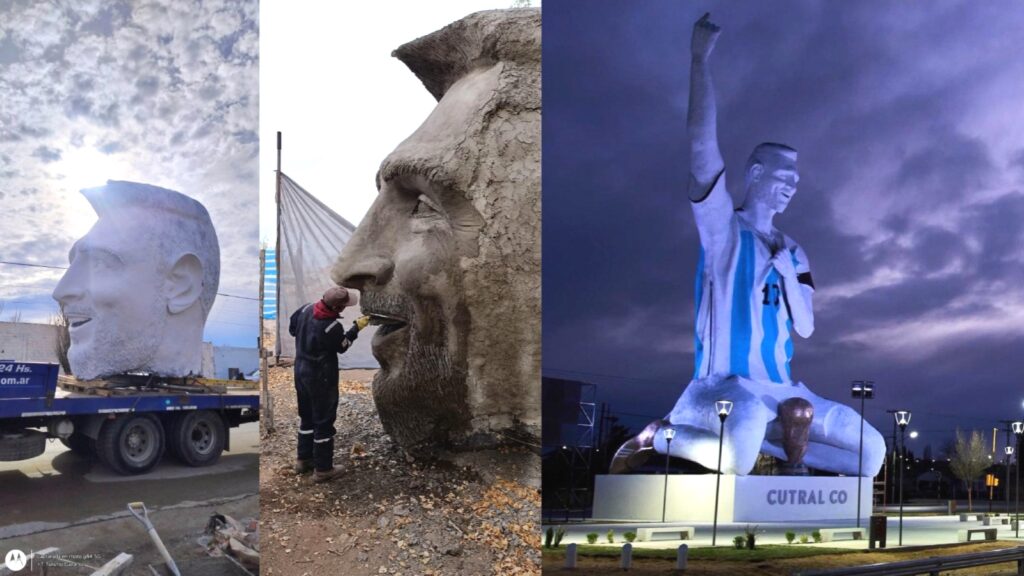
A new giant statue of Lionel Messi now stands in Argentina, and it is taller than the famous one that once stood in Kolkata. The new statue rises 85 feet into the sky in a small town called Cutral Co. It was unveiled on June 16, timed perfectly with Argentina’s opening match of the World Cup season.
This statue tells a story. It shows Messi on his knees, right after Argentina won the 2022 World Cup final in a penalty shootout at Lusail Stadium. In one hand, he holds the Argentina jersey close to his chest. His other hand points up to the sky, a gesture he always makes to remember his grandmother, who passed away many years ago.
The man behind this huge creation is sculptor Aldo Beroisa. He is 61 years old and has built large sculptures before, including giant dinosaurs and monuments honoring Argentina’s independence heroes. But nothing he built before caused as much talk and attention as this Messi statue.
The Kolkata Connection
Before this statue went up, there was another giant Messi statue in Kolkata, India. That one stood 70 feet tall. However, on June 1, workers took it down. Officials said it was not safe anymore because it moved too much whenever strong winds blew through the area.
Just a few weeks after Kolkata’s statue came down, Argentina’s new and taller version went up in its place as the world’s biggest Messi statue. When people asked Beroisa what he thought about Kolkata’s statue and how people reacted to it, he gave a kind and simple answer. He said every artist has full freedom to express their ideas through their work, and every point of view deserves respect.
He also spoke warmly about how much people in India love Messi. He said it fills Argentines with pride and gratitude to know that someone from their country is loved so much in a place so far away.
Building in the Desert
Cutral Co sits in a tough location. It lies in the Patagonian steppe, which is actually the eighth-largest desert on the entire planet. Mountains from the Andes sit on one side, and the Atlantic Ocean’s moisture barely reaches the area on the other side. This makes water very hard to find in this region.
Beroisa mentioned that getting enough water for this kind of project was a real challenge. Still, he felt that building something this big under such hard desert conditions made the whole project mean even more to him.
The local Sports Secretary of the Cutral Co Municipality gave Beroisa 18 months to finish designing and building this massive statue. To make it, workers used about 70 tons of steel. They also added rebar, which are metal rods used to strengthen concrete, along with three different grades of concrete mortar to keep everything sturdy.
In total, the team used around 110 structural steel tubes to build the frame of this giant statue. This method allowed them to create something both huge and strong enough to last a long time.
The Hardest Part: Getting the Face Right
Out of the entire eighteen months of work, most of the time went into just one part of the statue: Messi’s face. Beroisa said this was clearly the hardest part of the whole project.
For months, he studied hundreds of videos and photos of Messi from many different angles. He wanted to capture not just how Messi looks, but also something deeper, the true feeling and spirit of who Messi is as a person and as a football legend.
The sheer size of the statue made this task even harder. Beroisa explained that Messi is such a famous and important figure around the world today, so getting his face right carried a huge responsibility. Just imagine this: Messi’s head alone stands 4.30 meters tall on this statue and weighs close to four tons. Beroisa spent nearly three full months working only on the head, trying to add as much fine detail as he possibly could.
From the very beginning, Beroisa understood how important and difficult this whole project would turn out to be. He said he knew right away this would become one of his most important works ever.
Why He Took the Project
When asked why he agreed to build this massive statue in the first place, Beroisa gave a heartfelt answer. He described Messi as a man whose humility, hard work, and dedication gave Argentina one of the happiest moments in the country’s entire history.
That moment, of course, was Argentina winning the World Cup in 2022. For millions of people across the country, that win meant everything, and Beroisa wanted his statue to capture and honor that feeling.
How Desert Winds Changed the Design
One of the most interesting parts of this whole story is how the desert wind actually changed the statue’s final design. In Cutral Co, wind speeds normally reach 60 to 80 kilometers per hour on a regular day. On a bad day, the wind can blow as fast as 150 kilometers per hour.
Beroisa’s first plan was very different from how the statue looks now. Originally, he wanted Messi to hold the World Cup trophy high up in one hand, almost like Messi does in real photos after winning the final.
However, as engineers studied the design more carefully, they realized this plan would not be safe. The trophy itself, if built to match the huge scale of the statue, would stand almost four meters tall on its own. Holding something that large and heavy up in the air, on top of a statue that already stands 85 feet tall, would create serious safety problems in such strong desert winds.
Beroisa explained that the original idea was never to place the trophy down near the statue’s legs. The plan always called for the trophy to be lifted up in one hand. But once engineers ran their calculations, they found this design would be unsafe. So the placement changed.
Where Physics Put the Trophy
In the end, physics decided where the trophy would go. Since holding it high up in the air was too risky because of the wind, the trophy now sits lower down, level with Messi’s knees. This is where it remains today.
This one detail, the trophy sitting near the knees instead of held high in the air, has become the part of the statue that gets the most reactions online. People often laugh or joke about it before they talk about anything else in the design. Beroisa said this reaction did not surprise him much, since he understood beforehand that people might find this small change amusing.
A Sculpture for the Whole Country
Beroisa hopes the statue means more than just being big or breaking records for size. He said he hopes this sculpture goes beyond just being famous locally in Cutral Co and instead becomes something important to all of Argentina.
Right now, the statue still needs some finishing touches before it is fully complete. But even without those final details, it has already managed to do something its Kolkata predecessor could not: it has stayed standing strong in tough desert winds.
In Cutral Co, keeping a statue standing was never something anyone could take for granted, especially with such strong winds blowing through the desert regularly. The wind decided where the trophy would go first. After that, everything else about the project, from finding enough water in the desert, to using tons of steel, to Beroisa spending eighteen months of careful work, all had to work around the same harsh desert conditions before Messi could finally stand tall in bronze.