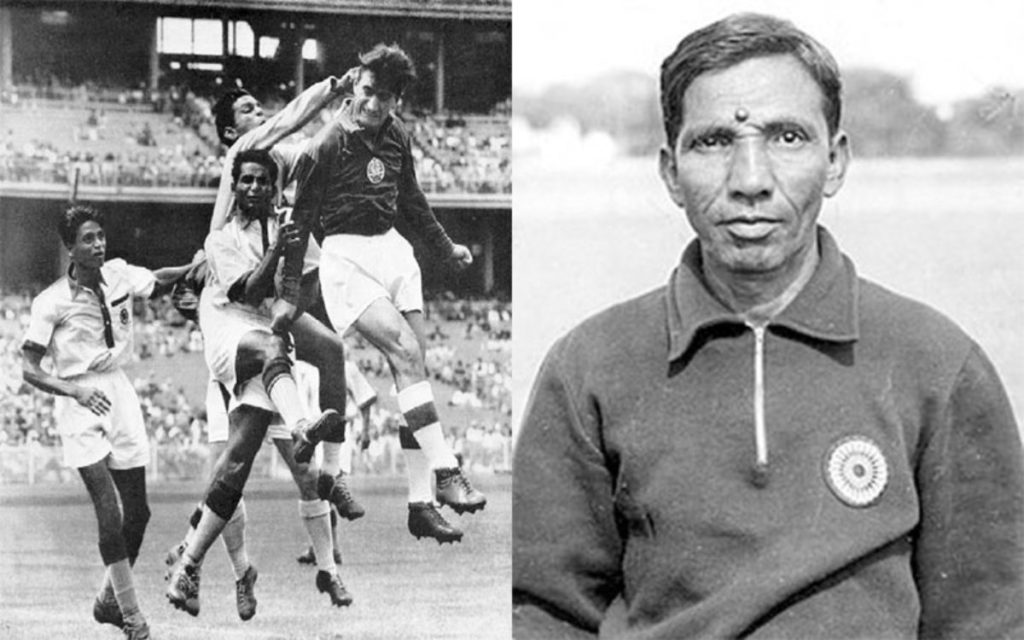
Top Five Indian Football Coaches Who Led the National Team
Indian football has experienced the influence of several exceptional tacticians who have been instrumental in the development of the sport within the nation. These iconic coaches not only led the national team but also made a lasting impression on Indian football. Below is a ranking of the top five Indian coaches who have managed the national team, presented from fifth to first place.
5. Amal Dutta :
Amal Dutta was a pioneering coach and a prominent figure in the annals of Indian football. He gained recognition for his introduction of tactical innovations, especially within club football, which he subsequently applied at the national level.
Dutta, who played as a midfielder for India, transitioned into coaching and transformed the team’s methodology by incorporating contemporary strategies.
He was the first Indian footballer to pursue formal coaching education in England, where he acquired insights from advanced European training techniques.
Among his notable tactical contributions was the “Diamond System,” which he employed during his coaching tenures with several teams.
4. Syed Nayeemuddin:
Syed Nayeemuddin is widely regarded as a prominent figure in Indian football, recognized for his disciplined approach to coaching.
As a former captain of the Indian national team and a recipient of the Arjuna Award, he effectively translated his leadership skills into his coaching endeavors.
In the late 1990s, he was appointed as the head coach of the Indian football team, where he played a pivotal role in achieving significant milestones.
Under his leadership, India secured the 1997 SAFF Championship, a landmark victory in the region.
He emphasized defensive strength while fostering the growth of emerging talents. His rigorous and disciplined methodology received both acclaim and criticism; however, it undeniably introduced a sense of accountability and organization to Indian football.
Additionally, Nayeemuddin contributed to prestigious Indian clubs such as Mohun Bagan and East Bengal, leading them to numerous domestic championships.
3. Armando Colaco:
Armando Colaco is highly esteemed for his remarkable contributions to club football, especially during his tenure with Dempo SC, prior to assuming the role of head coach for the Indian national team.
His coaching philosophy emphasized a possession-oriented and attacking style of play, which was relatively innovative for Indian football at that time.
In 2010, he took on the position of interim coach for the Indian team, aiming to implement his tactical framework within the national squad.
Under his leadership, the team adopted a more dynamic and offensive strategy, focusing on short passing and intelligent movement. Colaco’s achievements at Dempo, where he secured multiple I-League titles, demonstrated his capability to create and maintain a successful team.
Although his time with the national team was brief, his impact on the evolution of Indian football tactics was profound.
He played a crucial role in nurturing future talents and enhancing the overall technical proficiency of Indian players.
2. PK Banerjee:
Pradip Kumar Banerjee, widely recognized as PK Banerjee, stands as one of the most influential figures in Indian football, excelling both as a player and a coach.
He was part of India’s illustrious generation, participating in the 1960 Rome Olympics and securing a gold medal at the 1962 Asian Games.
As a coach, he perpetuated his winning ethos, leading the Indian national team to notable achievements in international competitions.
His significant influence was evident during India’s victory in the 1971 Pesta Sukan Cup, an international invitational event held in Singapore.
His remarkable contributions to Indian football were acknowledged with the FIFA Fair Play Award, highlighting his lasting legacy in the sport.
1. Syed Abdul Rahim :
Syed Abdul Rahim is widely acknowledged as the preeminent Indian football coach in history and the architect of India’s most prosperous period in the sport.
He managed the Indian national team from 1950 to 1963, a timeframe recognized as the golden era of Indian football.
During his tenure, India secured the gold medal at the Asian Games in 1951 and 1962, establishing itself as one of the leading footballing nations in Asia.
He also led the team to the semi-finals of the 1956 Melbourne Olympics, a milestone that stands as one of the nation’s most significant football accomplishments.
Rahim prioritized fitness, discipline, and a systematic approach to play, enabling India to compete effectively against top Asian teams.
His coaching philosophy emphasized teamwork, tactical insight, and technical advancement, which greatly enhanced the global reputation of Indian football.
Despite facing challenges related to limited resources and infrastructure, he developed a competitive squad capable of taking on some of Asia’s finest teams.
The legacy of Syed Abdul Rahim is unparalleled, and his contributions to Indian football continue to motivate emerging coaches and players.