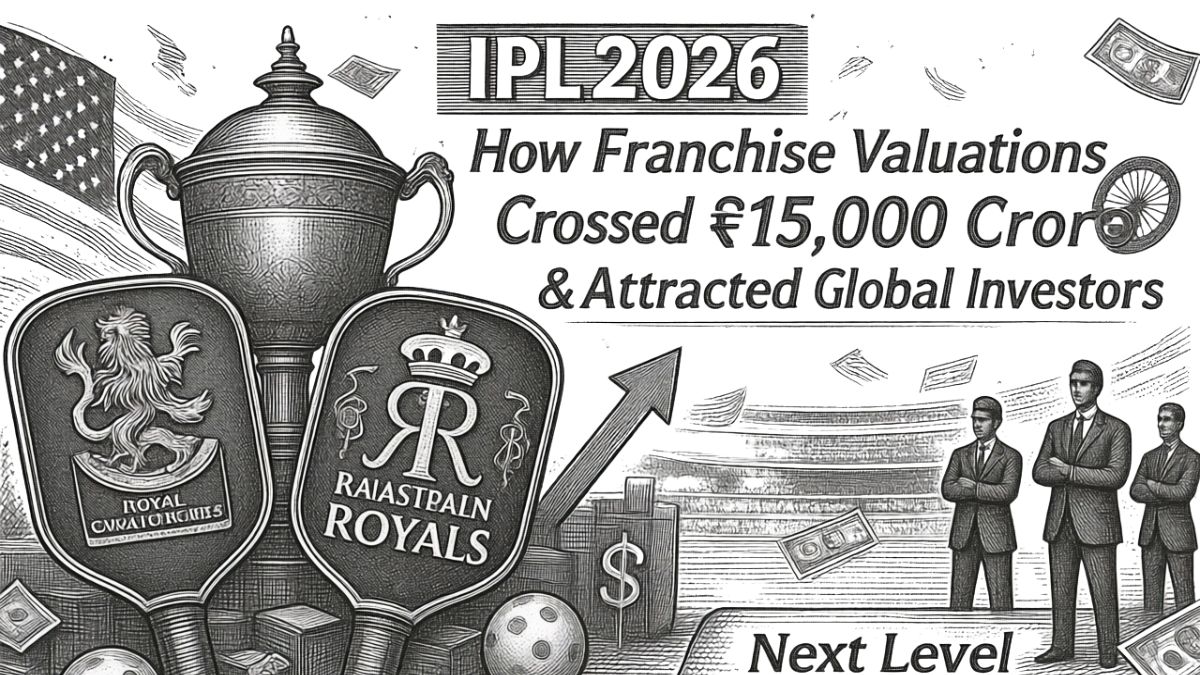
The Indian Premier League (IPL) has steadily evolved from a cricket tournament into one of the most sophisticated sports business ecosystems in the world. What began in 2008 as an ambitious experiment in franchise-based T20 cricket has now transformed into a multi-billion-dollar valuation game, attracting global investors, private equity giants, and legacy business houses. The latest developments surrounding the ownership transitions of franchises like Rajasthan Royals and Royal Challengers Bangalore clearly underline how the league has entered a new financial orbit.
At the heart of this evolution lies the increasing realization that IPL franchises are no longer just cricket teams—they are scalable sports assets with long-term enterprise value. The reported acquisition of Rajasthan Royals by US-based entrepreneur Kal Somani, in a deal valued at approximately ₹15,300 crore, marks a watershed moment. The involvement of global capital, including consortium participation from National Football League (NFL) franchise stakeholders and Rob Walton—heir to the Walmart fortune—signals a paradigm shift in how IPL teams are perceived internationally.
This is not merely a case of ownership change; it is a structural redefinition of sports investments in India. The entry of NFL-linked stakeholders reflects a cross-league strategic alignment where learnings from mature sports ecosystems like the United States are being integrated into the IPL framework. Franchise owners today are looking beyond match-day revenues and broadcasting rights, focusing instead on data monetization, fan engagement platforms, global merchandising, and digital ecosystems.
Similarly, the ₹16,600 crore acquisition of Royal Challengers Bangalore by a consortium featuring the Aditya Birla Group, The Times Group, Bolt Ventures, and Blackstone highlights the institutionalization of IPL ownership. These are not passive investors; they bring strategic depth across industries—media, infrastructure, capital markets, and global investments—creating a multi-layered growth engine for the franchise.
The appointment of Aryaman Birla as Chairman of RCB adds an interesting narrative dimension. Having previously been part of the Rajasthan Royals squad, Aryaman represents the convergence of sporting experience and corporate leadership. His dual exposure could prove critical in aligning on-field performance metrics with off-field valuation goals. Alongside him, Sanjay Gajwani stepping in as Vice Chairman from the Times Group brings in strong media leverage—an increasingly crucial factor in sports monetization.
From a financial standpoint, these valuations indicate a steep upward trajectory in franchise pricing. When IPL teams were initially sold in 2008, their valuations ranged between $67 million and $112 million. Fast forward to 2026, and we are witnessing deals crossing ₹15,000 crore, implying valuations well above $1.8–2 billion per franchise. This exponential growth is fueled by multiple factors—lucrative media rights deals, a massive and growing digital audience, sponsorship inflows, and the IPL’s ability to consistently deliver high engagement metrics.
The media rights cycle, particularly, has been a game-changer. With broadcasting and digital streaming deals collectively worth billions of dollars, franchises are assured of stable central revenue distributions. This financial predictability makes IPL teams highly attractive to institutional investors and private equity funds seeking long-term, stable returns with upside potential.
Another critical factor is the IPL’s demographic advantage. India’s young population, increasing internet penetration, and rising disposable incomes have created a fertile ground for sports consumption. Franchises are leveraging this by building direct-to-consumer platforms, launching fan tokens, and expanding their presence across social media and OTT ecosystems. The IPL is no longer limited to a two-month tournament—it is a year-round engagement platform.
The entry of global investors like Blackstone also indicates a shift toward professional governance and operational efficiency. Private equity firms typically focus on value creation through structured growth strategies, cost optimization, and eventual exit opportunities. This could lead to innovations such as multi-team ownership models, global league integrations, and even potential IPOs of franchises in the future.
Moreover, the cross-border capital inflow into IPL franchises enhances the league’s global positioning. With stakeholders from the US and Europe, the IPL is increasingly being seen as a template for franchise-based sports leagues worldwide. This also opens doors for collaborations with leagues like the NFL, NBA, and EPL, further strengthening the IPL’s international footprint.
However, these rising valuations also come with inherent risks. The sustainability of such high valuations depends on consistent revenue growth, regulatory stability, and the league’s ability to maintain its competitive balance. Any disruption—be it in media rights, sponsorship trends, or audience engagement—could impact the long-term financial outlook.
Additionally, as ownership structures become more complex, governance challenges may arise. Balancing the interests of multiple stakeholders while ensuring sporting integrity will be crucial. The Board of Control for Cricket in India (BCCI) will play a pivotal role in maintaining regulatory oversight and ensuring that the league’s commercial ambitions do not overshadow its sporting ethos.
In conclusion, the IPL has unmistakably entered a new phase—one defined by high-stakes investments, global capital participation, and sophisticated financial engineering. The acquisitions of Rajasthan Royals and Royal Challengers Bangalore are not isolated events; they are indicators of a broader transformation where cricket franchises are being valued as premium global sports assets.