How Much Do Indian Pickleball Players REALLY Earn in 2026? (No Hype, Only Reality Check)
Courts are coming up across metro cities, communities are forming rapidly, and the sport is gaining visibility on social media.
But beyond the hype of “fastest-growing sport” and “future opportunity,” one fundamental question remains:
Are Indian pickleball players actually making money in 2026?
India vs Global Reality: A Massive Gap
Top-ranked players are earning upwards of $1 million (~₹8.5 crore annually) through a combination of contracts, prize money, and sponsorships.
India, however, is still in the early ecosystem-building phase.
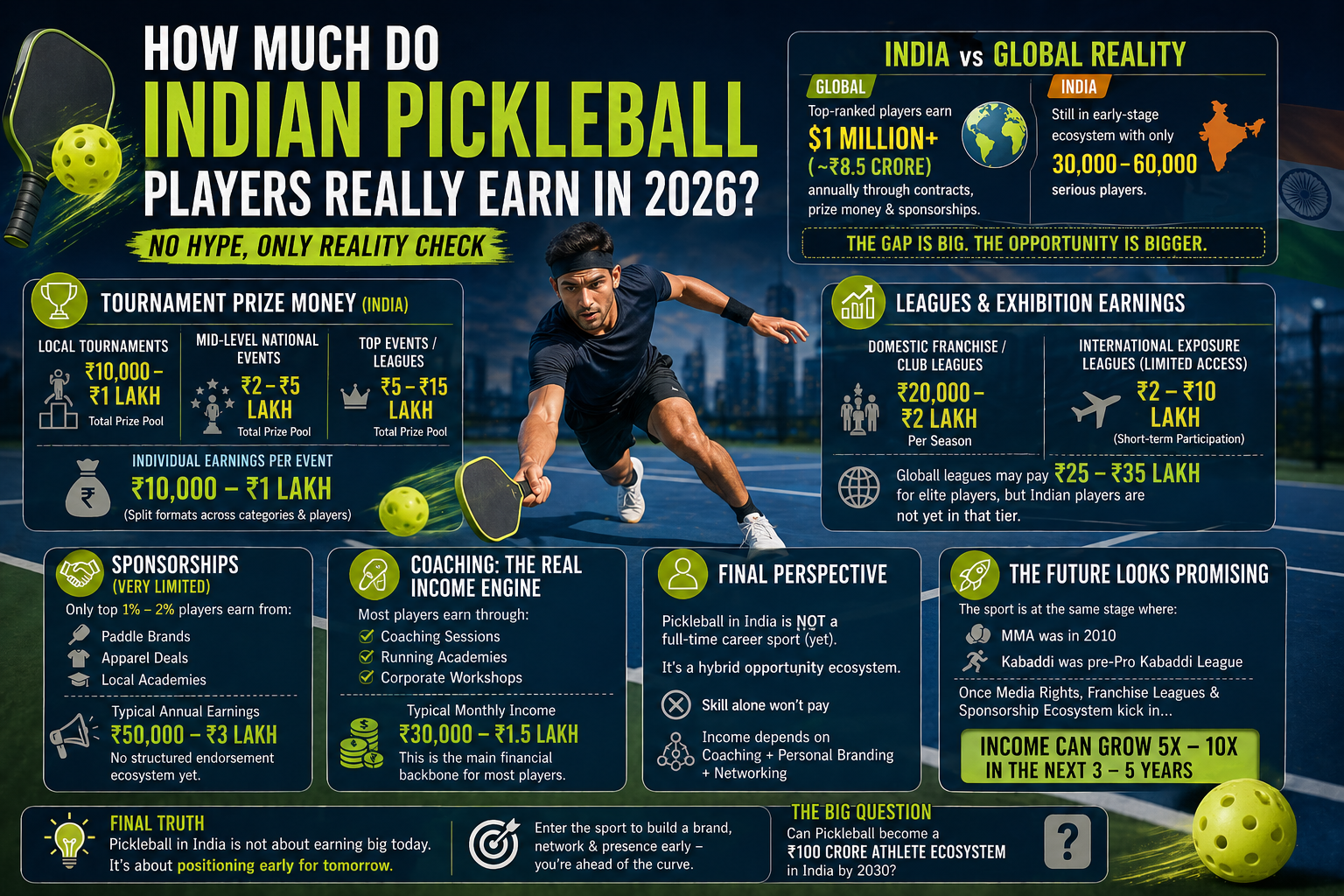

With an estimated 30,000–60,000 serious players, the sport is far from mature in terms of infrastructure, monetization, and professional pathways.
The gap isn’t just large—it defines the current reality.
Tournament Prize Money: Modest at Best
The backbone of any sport’s earnings structure is tournament prize money. In India, this remains limited:
Local tournaments: ₹10,000 – ₹1 lakh total prize pool
Mid-level national tournaments: ₹2 – ₹5 lakh
Top-tier events/leagues: ₹5 – ₹15 lakh
Even at the highest level, prize pools are relatively small—and importantly, distributed across multiple categories and players.
What does an individual player actually earn?
Typically ₹10,000 – ₹1 lakh per event
League & Exhibition Earnings: Early but Promising
Leagues and exhibition matches are emerging as a better-paying avenue—but still at a nascent stage.
Domestic franchise/club leagues: ₹20,000 – ₹2 lakh per season
International exposure leagues (limited access): ₹2 – ₹10 lakh (short-term participation)
While international circuits may offer significantly higher payouts (₹25–35 lakh for elite global players), Indian domestic players are not yet part of that financial tier.
Sponsorships: A Narrow Funnel
Brand endorsements and sponsorships are critical in modern sports—but in Indian pickleball, this revenue stream is highly restricted.
Only the top 1–2% of players currently benefit from:
Paddle brand deals
Apparel partnerships
Local academy affiliations
Typical annual sponsorship earnings:
There is no structured endorsement ecosystem yet, unlike cricket, badminton, or even emerging leagues like kabaddi.
Coaching: The Real Income Engine
Here’s the most important—and often overlooked—truth:
Coaching is the primary source of income for most Indian pickleball players.
Coaching sessions
Running academies
Conducting corporate workshops
Typical monthly income from coaching:
For many players, this is not a side income—it is the main financial backbone.
Final Perspective: Not a Career Sport (Yet)
Despite its rapid growth, pickleball in India is not yet a full-time professional sport.
It currently operates as a hybrid opportunity ecosystem, where:
Income depends on coaching + personal branding + networking
Players who succeed financially are those who diversify beyond just playing.
While the present may seem underwhelming, the future holds significant potential.
The sport today is at a stage comparable to:
MMA in India around 2010
Kabaddi before the launch of the Pro Kabaddi League
Media rights
Structured franchise leagues
Strong sponsorship ecosystem
Player earnings could grow 5–10x within the next 3–5 years.
Final Truth
Pickleball in India is not about earning big today.
It is about positioning yourself early for tomorrow’s ecosystem.
If you’re entering the sport expecting immediate financial success—you may be disappointed.
But if you’re building a brand, network, and presence early—you’re ahead of the curve.
The Big Question
Can pickleball evolve into a ₹100 crore athlete ecosystem in India by 2030?
The answer will depend not just on players—but on leagues, media, investors, and the broader sports business ecosystem.
| Category | Key Insights | Earnings Range / Data | Reality Check |
|---|---|---|---|
| Ecosystem Stage | India vs Global comparison | Global top players earn ~₹8.5 Cr/year | India is still in early-stage ecosystem (30,000–60,000 serious players) |
| Tournament Prize Pools | Local tournaments | ₹10,000 – ₹1 lakh | Very small prize pools |
| Mid-level national tournaments | ₹2 – ₹5 lakh | Limited scalability | |
| Top-tier events | ₹5 – ₹15 lakh | Still developing | |
| Individual Tournament Earnings | Per player per event | ₹10,000 – ₹1 lakh | Not sustainable as primary income |
| League Earnings (India) | Franchise/club leagues | ₹20,000 – ₹2 lakh per season | Emerging but inconsistent |
| International League Exposure | Limited Indian participation | ₹2 – ₹10 lakh (short-term) | Access restricted to few players |
| Global League Benchmark | Elite global players | ₹25 – ₹35 lakh (short stint) | Indian players not yet in this tier |
| Sponsorship Earnings | Top 1–2% players only | ₹50,000 – ₹3 lakh annually | No structured endorsement ecosystem |
| Revenue Sources (Sponsorship) | Types | Paddle brands, apparel, academies | Very limited deals available |
| Primary Income Source | Coaching & training | ₹30,000 – ₹1.5 lakh/month | Backbone of earnings in India |
| Coaching Activities | Income streams | Coaching, academies, corporate workshops | Essential for survival |
| Career Viability | Full-time profession? | ❌ Not yet | Hybrid model only |
| Earning Model | How players earn | Playing + Coaching + Personal Branding + Networking | Diversification is key |
| Growth Stage Comparison | Similar to | MMA (2010), Kabaddi pre-Pro Kabaddi League | Early growth phase |
| Future Growth Drivers | Key factors | Media rights, leagues, sponsorships | Critical for scaling income |
| Projected Growth | Next 3–5 years | 5x – 10x potential increase | Depends on ecosystem development |
| Final Reality | Current state | Not about big earnings today | Focus on early positioning |
| Strategic Insight | For players | Build brand + network early | Long-term advantage |
| Big Question | Future outlook | ₹100 Cr athlete ecosystem by 2030? | Depends on stakeholders |
Frequently Asked Questions: Indian Pickleball Earnings in 2026
1. Can Indian pickleball players earn a full-time income in 2026?
At present, pickleball in India is not a fully sustainable full-time career for most players. While the sport is growing rapidly, the financial ecosystem is still developing. Tournament winnings alone are not sufficient to cover living expenses, and only a small percentage of players benefit from sponsorships or league contracts. As a result, most competitive players adopt a hybrid model—combining playing with coaching, training programs, or other related activities. Those who diversify their income streams tend to achieve better financial stability. Until structured leagues, consistent sponsorships, and media-backed tournaments become more prominent, relying solely on playing professionally remains challenging in India.
2. What are the main sources of income for pickleball players in India?
The primary income sources for Indian pickleball players extend beyond just competition. While tournaments and emerging leagues offer some earnings, the most reliable income stream currently comes from coaching. Players often conduct individual or group coaching sessions, run academies, or collaborate with sports facilities. Additionally, some players earn through corporate workshops, exhibition matches, and occasional sponsorship deals. However, brand endorsements are limited to a small percentage of top players. This makes coaching and community engagement the backbone of financial sustainability. In simple terms, players who treat pickleball as both a sport and a service-based profession tend to earn more consistently.
3. How does India compare with the global pickleball earning ecosystem?
Globally, pickleball has already established itself as a commercially viable sport, especially in countries like the United States. Top international players earn substantial amounts through contracts, endorsements, and prize money. In contrast, India is still in the early stages of building its ecosystem. The number of serious players is relatively low, infrastructure is expanding but not yet widespread, and financial investments are limited. This creates a significant gap in earning potential. However, this gap also signals opportunity—India is at a stage where early entrants can build visibility and long-term value as the sport evolves.
4. What is the future earning potential of pickleball in India?
The future outlook for pickleball in India is promising, provided key developments take place. The introduction of structured franchise leagues, increased media coverage, and stronger brand participation could significantly enhance player earnings. If the ecosystem grows in a similar way to sports like kabaddi before the Pro Kabaddi League, income opportunities could multiply over the next few years. Experts believe that player earnings could increase several times within the next 3–5 years if the right investments and systems are put in place. For now, the sport offers more value as a long-term opportunity rather than immediate financial gain.
Related posts: