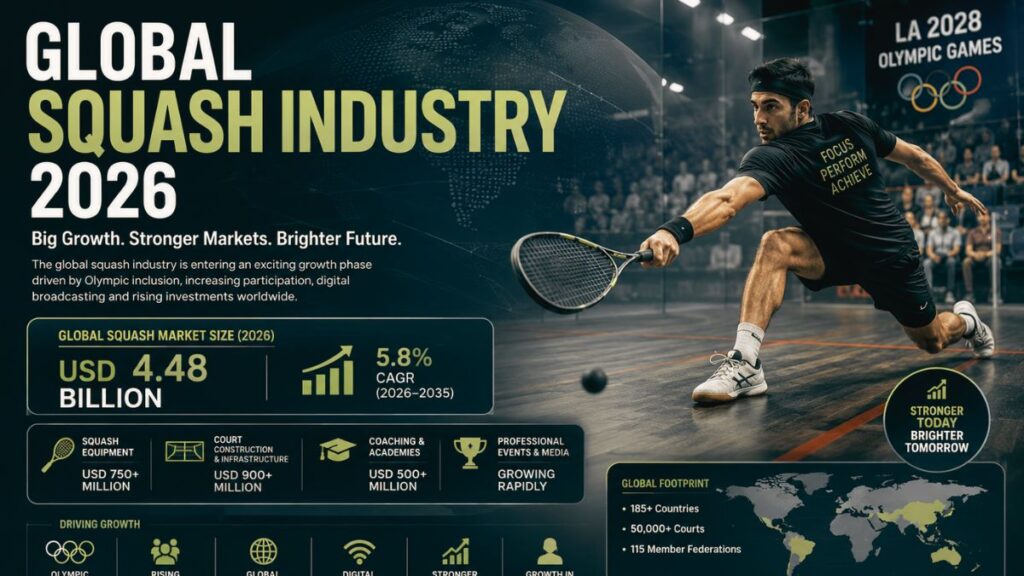
The global squash industry is entering one of its most significant growth phases in 2026. After years of remaining a niche racquet sport, squash is witnessing increased commercial interest due to its inclusion in the 2028 Los Angeles Olympics, growing participation across Asia and the Middle East, digital broadcasting, and expanding investments in sports infrastructure. Countries such as Egypt, India, the United States, England, Malaysia, Australia, and France are becoming key growth markets, while professional tours continue attracting larger audiences.
Industry estimates suggest that the global squash market will reach approximately USD 4.48 billion in 2026, with long-term projections indicating steady growth through 2035 at nearly 5.8% CAGR.
Global Squash Market Size
The squash ecosystem extends beyond professional tournaments. It includes equipment manufacturing, court construction, coaching academies, sports tourism, broadcasting rights, sponsorships, fitness clubs, and technology-driven training solutions.
Estimated Global Squash Industry (2026)
Segment Estimated Value
Overall Squash Market USD 4.48 Billion
Squash Equipment USD 750+ Million
Court Construction & Infrastructure USD 900 Million+
Coaching & Academies USD 500 Million+
Professional Events & Media Growing Rapidly
The industry’s expansion is driven by increasing health consciousness, urban indoor sports facilities, and Olympic recognition.
Why the Squash Industry Is Growing
Several factors are accelerating squash’s commercial growth worldwide:
Olympic inclusion for Los Angeles 2028
Rising investments by private clubs
Expansion of premium fitness centres
Growth of youth development programmes
Increased participation among women
Technology-based coaching
Strong grassroots initiatives
Growth of professional tournaments
Digital media consumption
Sponsorship Market
Corporate sponsorship has become a major revenue source for squash. Global brands are increasingly investing in tournaments, athletes, and equipment partnerships.
Major Sponsorship Categories
Sports equipment manufacturers
Banking institutions
Luxury automobile brands
Airlines
Health and nutrition companies
Technology firms
Hospitality partners
Leading equipment brands include Tecnifibre, HEAD, Dunlop, Karakal, Eye Rackets, Oliver, and Prince, all of which sponsor elite professionals and international tournaments.
Countries like Egypt have also attracted substantial government and private investment into player development, helping dominate international rankings.
Live Streaming and Broadcasting
Broadcasting has transformed the visibility of squash over the past decade.
The PSA Squash Tour now reaches fans through digital streaming, allowing audiences to watch tournaments worldwide. The official SQUASHTV platform streams more than 1,000 matches annually, while selected events are also distributed through regional broadcast partners.
Major Broadcasting Platforms
SQUASHTV
Regional Sports Networks
JioHotstar (selected events in India)
Star Sports (selected tournaments)
YouTube Highlights
Social Media Live Coverage
Digital broadcasting has significantly increased fan engagement, particularly among younger audiences who consume sports primarily through streaming platforms.
Participation Across the World
Squash continues to expand globally.
The sport is played across more than 185 countries, supported by approximately 50,000 squash courts worldwide. The international governing body now consists of 115 member federations, reflecting its broad global footprint.
Leading squash nations include:
Egypt
England
India
Malaysia
France
United States
Australia
Pakistan
Egypt remains the dominant powerhouse, producing multiple world champions and setting the benchmark for player development.
India’s Squash Market
India has emerged as one of Asia’s fastest-growing squash markets.
Growing awareness, international success by Indian athletes, corporate leagues, and improved infrastructure have all contributed to increasing participation.
Several metropolitan cities now have premium squash facilities, including:
Delhi NCR
Mumbai
Bengaluru
Chennai
Hyderabad
Pune
School competitions, university championships, and national ranking tournaments continue expanding the talent pipeline.
The sport has also gained greater visibility following India’s strong performances at the Asian Games and international team competitions.
Equipment Market
The equipment segment remains one of the largest commercial components of the squash industry.
Popular products include:
Professional racquets
Training racquets
Squash balls
Shoes
Protective eyewear
Apparel
Grip accessories
Coaching equipment
Premium graphite racquets continue driving equipment sales, while online retail has significantly improved accessibility worldwide.
Infrastructure Investment
Court development is expanding rapidly across:
Commercial clubs
Universities
Hotels
Residential communities
Sports academies
Government sports centres
Private fitness chains increasingly view squash as a premium offering capable of attracting affluent urban consumers.
Technology Changing Squash
Technology has become a major differentiator in professional and amateur squash.
Key innovations include:
AI-powered coaching
Smart wearable devices
Performance analytics
Video replay systems
Motion tracking
Virtual coaching platforms
Online coaching subscriptions
These technologies help players analyse movement, improve shot selection, and monitor physical performance.
Commercial Opportunities
The squash business ecosystem now extends well beyond tournament prize money.
Revenue opportunities include:
Broadcasting rights
Sponsorships
Equipment sales
Coaching academies
Membership clubs
Event management
Sports tourism
Digital subscriptions
Brand endorsements
With Olympic recognition approaching, these commercial opportunities are expected to accelerate further.
Challenges Facing the Industry
Despite strong momentum, several challenges remain:
Limited television exposure compared to tennis
High cost of court construction
Shortage of certified coaches in emerging markets
Limited grassroots awareness
Competition from pickleball and padel
Uneven sponsorship distribution
Future Outlook
The outlook for the squash market is highly optimistic.
Olympic inclusion is expected to unlock greater government funding, increased sponsorship activity, broader media coverage, and higher participation rates across both developed and emerging markets. Countries such as India are likely to witness stronger investments in academies, tournaments, and community infrastructure, while digital platforms will continue expanding the sport’s global audience.
With a projected market value of USD 4.48 billion in 2026 and steady long-term growth, squash is evolving from a niche indoor sport into a commercially attractive global industry. Continued investment in broadcasting, grassroots development, technology, and sponsorships positions squash for sustained expansion over the next decade.
How will the Los Angeles 2028 Olympics influence the global squash industry and India’s growth?
The inclusion of squash in the Los Angeles 2028 Olympic Games is expected to become the biggest catalyst for the sport’s global commercial and participation growth. Olympic recognition provides international legitimacy, encouraging governments, sports federations, educational institutions, and private investors to allocate greater funding toward athlete development, coaching programmes, infrastructure, and grassroots initiatives. Countries aiming to qualify athletes for the Olympics are likely to establish new academies, improve coaching standards, and increase domestic competitions to strengthen their talent pipelines.
For the global squash industry, Olympic inclusion is expected to generate higher media visibility, attract larger sponsorship deals, and encourage broadcasters to expand tournament coverage. Equipment manufacturers are also likely to benefit from rising demand for racquets, shoes, apparel, balls, and training accessories as participation increases across different age groups. Digital platforms such as streaming services and coaching applications are expected to witness higher engagement from new players seeking professional guidance and live tournament coverage.
India stands among the countries that could benefit significantly from this momentum. With improving infrastructure, growing awareness, and successful international performances, the country has already emerged as one of Asia’s fastest-growing squash markets. Olympic recognition is likely to encourage both central and state governments to invest further in sports facilities, school-level competitions, university championships, and elite athlete support programmes. Corporate sponsorships may also increase as brands seek associations with emerging Olympic sports.
Additionally, sports tourism, coaching academies, residential sports communities, and premium fitness clubs could experience higher demand as squash gains mainstream popularity. Professional leagues and international tournaments hosted in India may attract greater participation from global athletes, boosting the country’s sporting ecosystem and economic opportunities.
Overall, the Los Angeles 2028 Olympics could transform squash from a niche indoor sport into a widely recognised global discipline, creating long-term commercial opportunities while inspiring millions of new players worldwide. This momentum is expected to sustain industry growth well beyond the Olympic cycle and strengthen squash’s position within the global sports economy.
| Aspect | Details |
|---|---|
| Olympic Recognition | The inclusion of squash in the Los Angeles 2028 Olympics is expected to be the biggest growth catalyst for the sport globally, providing international recognition and credibility. |
| Government Investment | Governments are likely to increase funding for athlete development, coaching programmes, grassroots initiatives, and sports infrastructure to prepare Olympic-level players. |
| Infrastructure Development | More squash courts, academies, high-performance centres, and training facilities are expected to be established worldwide. |
| Media & Broadcasting | Olympic exposure is expected to attract greater television coverage, digital streaming, and social media engagement, helping squash reach a much wider audience. |
| Sponsorship Growth | Global brands are likely to increase investments in tournaments, athletes, and equipment partnerships, creating stronger commercial opportunities. |
| Equipment Industry | Rising participation is expected to boost demand for racquets, balls, footwear, apparel, protective gear, and coaching equipment, benefiting manufacturers and retailers. |
| Technology Adoption | AI-powered coaching, wearable technology, motion tracking, video analytics, and virtual coaching platforms are expected to witness higher adoption among players and academies. |
| India’s Growth Potential | India is expected to benefit significantly through increased investments in academies, school competitions, university championships, elite training programmes, and national tournaments. |
| Corporate Participation | Companies may invest more in squash through sponsorships, corporate leagues, athlete endorsements, and sports infrastructure projects as Olympic interest grows. |
| Sports Tourism & Events | International tournaments, coaching camps, and sports tourism are expected to expand, generating additional economic opportunities for host cities. |
| Long-Term Outlook | Olympic inclusion is expected to transform squash from a niche indoor sport into a globally recognised discipline, strengthening participation, commercial revenues, infrastructure development, and the overall sports ecosystem for years beyond the 2028 Games. |