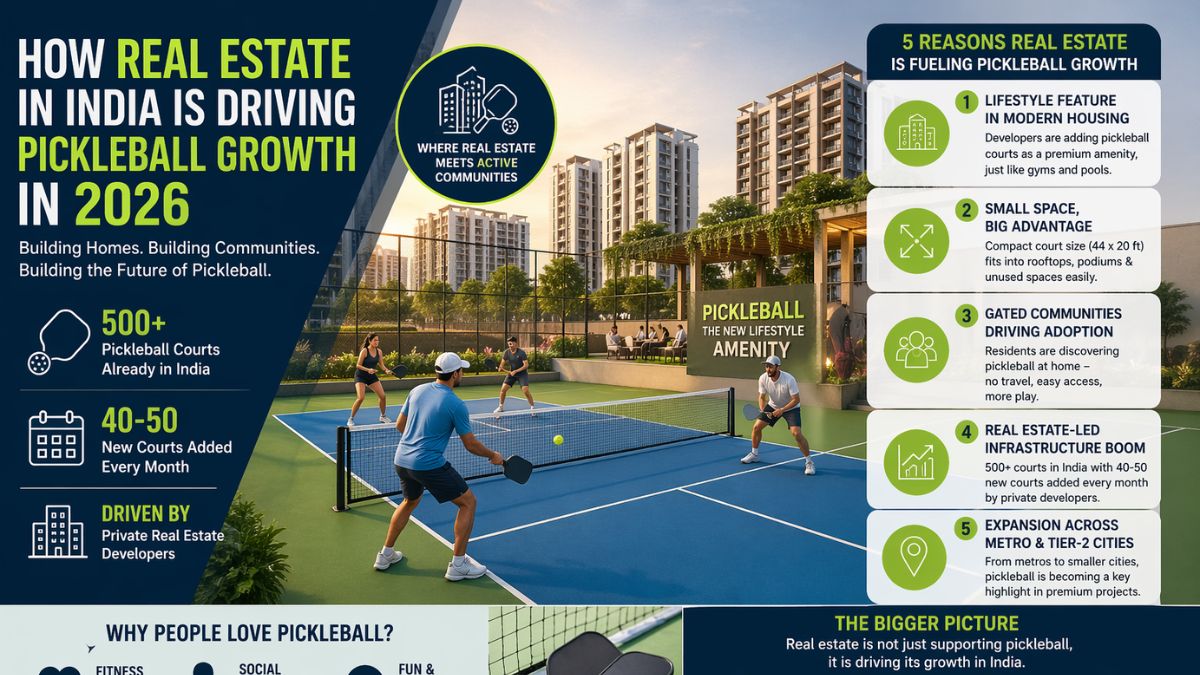
5 Reasons How Real Estate in India is Driving Pickleball Growth in 2026:
Pickleball, once considered a niche recreational sport, is rapidly transforming into one of India’s fastest-growing urban lifestyle activities.
In 2026, developers are not just building homes—they are building experiences. And pickleball is emerging as a key part of that ecosystem.
Here’s a closer look at how real estate is fueling the pickleball boom in India:
1. Pickleball as a Lifestyle Feature in Modern Housing
Real estate developers across India have begun positioning pickleball as a premium lifestyle offering. Much like gyms, swimming pools, and clubhouses once defined luxury living, pickleball courts are now becoming a symbol of modern, active communities.
Developers are integrating courts into rooftops, podium levels, basements, and open recreational areas. This strategic inclusion is not accidental—it caters directly to urban buyers who prioritize health, leisure, and community interaction.
Fact: Pickleball is now marketed alongside traditional amenities as a premium feature in residential projects.
Insight: In an increasingly competitive housing market, such differentiated offerings help developers stand out and appeal to younger, lifestyle-focused buyers.
2. Small Space, Big Advantage
One of pickleball’s biggest advantages is its compact court size—approximately 44 x 20 feet.
Unlike tennis or football, which require large expanses of land, pickleball can be accommodated within limited spaces. This allows developers to utilize underused or unconventional areas efficiently.
Fact: The small footprint makes pickleball ideal for urban real estate projects with space constraints.
Impact: Builders can convert idle zones into high-value recreational assets, enhancing both utility and property appeal without significant spatial compromise.
3. Gated Communities Are Accelerating Adoption
The rise of gated communities and integrated townships has significantly contributed to pickleball’s accessibility. Residents are increasingly discovering the sport within their own living spaces—be it housing societies, private clubs, or corporate campuses.
For many, their first exposure to pickleball happens just a few steps from their homes. This proximity removes common barriers associated with adopting a new sport.
Fact: A large percentage of new players are introduced to pickleball within their residential complexes.’

No travel required
When a sport is available within daily reach, it naturally becomes part of residents’ routines, driving sustained engagement.
4. Real Estate-Led Infrastructure Boom
India currently has over 500 pickleball courts, with an estimated 40–50 new courts being added every month. A significant portion of this growth is being driven by private real estate developers rather than traditional sports bodies.
From premium housing societies to mixed-use developments and lifestyle clubs, pickleball infrastructure is expanding at an unprecedented pace.
Residential complexes
Private clubs
Insight: The rapid expansion of courts is largely market-driven, reflecting consumer demand rather than institutional push.
5. Expansion Across Metro and Tier-2 Cities
While metropolitan cities like Mumbai, Delhi, and Bengaluru are leading the initial wave, pickleball is no longer confined to urban elites. Tier-2 cities are quickly catching up, driven by evolving buyer preferences and competitive real estate strategies.
Luxury housing projects are using pickleball to attract younger demographics, while emerging cities are adopting it as a marker of modern, aspirational living.
Fact: Even smaller cities are incorporating pickleball courts into premium residential developments.
Impact: This widespread adoption is ensuring that pickleball’s growth is not limited geographically but is expanding across
The popularity of pickleball is closely tied to what modern urban residents seek in their lifestyle:
Result: Pickleball aligns perfectly with the evolving concept of community living, where shared experiences and wellness take center stage.
Final Perspective
In 2026, the growth of pickleball in India is not being driven solely by sports organizations or professional leagues. Instead, it is being powered by the places where people live.
Real estate developers are playing a pivotal role by:
Building accessible infrastructure
Creating consistent demand
Enhancing lifestyle value within communities
This integration of sport into everyday living environments is what sets pickleball apart from traditional sports growth models.
One-Line Insight
👉 Pickleball in India is growing rapidly because it is being played where people live
| Section | Details |
|---|---|
| Introduction | Pickleball, once a niche recreational sport, is rapidly emerging as one of India’s fastest-growing urban lifestyle activities. In 2026, real estate developers are not just building homes—they are creating experiences, with pickleball becoming a key part of modern living ecosystems. |
| # | Reason | Explanation | Key Points |
|---|---|---|---|
| 1 | Pickleball as a Lifestyle Feature | Developers are positioning pickleball as a premium amenity, similar to gyms and swimming pools, integrated into rooftops, podiums, basements, and open spaces. | Fact: Marketed as a premium feature.Insight: Helps differentiate projects and attract young buyers. |
| 2 | Small Space, Big Advantage | With a compact court size (44 x 20 feet), pickleball fits easily into urban spaces where land is limited. | Fact: Ideal for space-constrained cities.Impact: Converts unused spaces into valuable amenities. |
| 3 | Gated Communities Driving Adoption | Residents are discovering pickleball within housing societies, clubs, and office campuses, increasing accessibility. | Fact: First exposure often happens at home.Why it matters: No travel needed.Result: Higher consistency in playing. |
| 4 | Real Estate-Led Infrastructure Boom | Over 500 courts exist in India, with 40–50 new courts added monthly, largely driven by private developers. | Where: Housing societies, clubs, mixed-use spaces.Insight: Growth is demand-driven, not federation-led. |
| 5 | Expansion Across Cities | Pickleball is spreading beyond metros into Tier-2 cities through premium housing projects. | Fact: Smaller cities adopting the sport.Impact: Nationwide growth, not limited to metros. |
| # | Reason | Explanation | Key Points |
|---|---|---|---|
| 1 | Pickleball as a Lifestyle Feature | Developers are positioning pickleball as a premium amenity, similar to gyms and swimming pools, integrated into rooftops, podiums, basements, and open spaces. | Fact: Marketed as a premium feature.Insight: Helps differentiate projects and attract young buyers. |
| 2 | Small Space, Big Advantage | With a compact court size (44 x 20 feet), pickleball fits easily into urban spaces where land is limited. | Fact: Ideal for space-constrained cities.Impact: Converts unused spaces into valuable amenities. |
| 3 | Gated Communities Driving Adoption | Residents are discovering pickleball within housing societies, clubs, and office campuses, increasing accessibility. | Fact: First exposure often happens at home.Why it matters: No travel needed.Result: Higher consistency in playing. |
| 4 | Real Estate-Led Infrastructure Boom | Over 500 courts exist in India, with 40–50 new courts added monthly, largely driven by private developers. | Where: Housing societies, clubs, mixed-use spaces.Insight: Growth is demand-driven, not federation-led. |
| 5 | Expansion Across Cities | Pickleball is spreading beyond metros into Tier-2 cities through premium housing projects. | Fact: Smaller cities adopting the sport.Impact: Nationwide growth, not limited to metros. |
| Category | Details |
|---|---|
| What People Want | Fitness, social interaction, fun activities |
| Why Pickleball Works | Easy to learn, inclusive, highly social |
| Result | Perfect fit for modern community living and shared experiences |
| Aspect | Details |
|---|---|
| Role of Real Estate | Real estate is not just supporting but actively driving pickleball growth in India |
| Key Contributions | Building courts, enabling discovery, creating demand, adding lifestyle value |
| Unique Factor | Sport is integrated into daily living environments |
| Insight |
|---|
| Pickleball in India is growing rapidly because people are playing it where they live, not because of traditional sports ecosystems. |
1. Why is pickleball growing so fast in India?
Pickleball is witnessing rapid growth in India primarily because it aligns well with modern urban lifestyles. It is easy to learn, requires minimal equipment, and is suitable for all age groups, making it highly inclusive. Unlike traditional sports that demand significant time and physical intensity, pickleball offers a balance of fitness and recreation. Additionally, the integration of courts within residential societies and gated communities has made the sport highly accessible. People are discovering and adopting it within their everyday environments, which naturally increases participation. The social aspect of pickleball also plays a key role, as it encourages interaction and community bonding.
2. How is real estate contributing to the growth of pickleball?
Real estate developers are playing a crucial role in promoting pickleball by incorporating courts as part of modern housing amenities. Just like gyms and swimming pools, pickleball is now being positioned as a lifestyle feature in premium and mid-segment projects. Due to its compact court size, developers can easily integrate it into rooftops, podiums, or unused spaces. This not only enhances the value of the property but also introduces residents to the sport without requiring additional travel. As more projects adopt this trend, pickleball is becoming a standard offering in new-age housing developments.
3. Is pickleball limited to metro cities in India?
No, pickleball is no longer limited to metro cities. While urban centers like Delhi, Mumbai, and Bengaluru have led the initial growth, Tier-2 cities are now actively embracing the sport. Real estate developments in smaller cities are also incorporating pickleball courts to attract modern buyers. This widespread adoption is helping the sport expand beyond elite urban communities and reach a broader audience. As infrastructure continues to grow across different regions, pickleball is steadily establishing itself as a nationwide recreational and lifestyle sport.
Related posts: